• HOME
  • INTERVIEWS
  • LOCATIONS GALLERY
  • MONOCHROMATIC PORTRAITS
  • ABOUT ME
  • PL
  • LINKS

JAMES BOND

~ Behind the Scenes of James Bond

JAMES BOND

Author Archives: Piotr Zając

Interview with Andreas Wisniewski who has played villain Necros in ‘The Living Daylights’

06 Sunday Dec 2020

Posted by Piotr Zając in Andreas Wisniewski, The Living Daylights

≈ Leave a comment

Tags

actor, Andreas Wisniewski, Behind the Scenes, filming location, interview, James Bond, Necros, Stonor House, The Living Daylights

Andreas Wisniewski is an ex-ballet dancer, actor and film director. For film enthusiasts and James Bond fans he is well known for his portrayals of Necros in ‘The Living Daylights’.


Piotr Zajac (bondlocations): How did you got the part in “The Living Daylights”? Did you take part in casting or did you get a call from the producers?

Andreas Wisniewski: It went pretty much the usual way. With the big film projects you don’t meet anybody unless you have an agent, who is already representing you. My agent submitted me but it was not enough to get the job of course. The agent always thinks that you are right for the part (laughing) but there are casting people and the producing site that have to think that you are right. You have to audition so I went to audition. I made a screen test. Escpecially if you are young and new and there isn’t a lot of material that people can see you in they want to know if you can do this.

I’ve heard that according to the script Necros looked exactly like you.

Yes. The character was described like I looked. They were just astonished. That was of course nice but not enough. I still had to convinced them that I could do it. Screen test was just as usual. I did a little scene and they had recorded it, so they could discuss about it later without me.

The first scene that you were filming was the fight in the kitchen with Bill Weston. Did you fight according to choreography or was it rather spontaneous? How long did you train for that? 

No, it was totally choreographed. The fight was choreographed to the detail. I had a few days of training before that which wasn’t really very much. I was a ballet dancer and at least I had some sort of physical awarness that I could fake a lot of things. That is what I did.

Did you bring your own ideas to the choreography of the fight?

I didn’t have any ideas at that time. I was blissfully ignorant of it all. I am sure that you know that for a stuntman it is not the greatest experience to be doing this with someone who is not fully trained. Bill broke a finger in the fight. I also slipped once and I hit him on the cheekbone and he was knocked out for a few seconds. That is the hazard of the profession.

Did you film the fight in Pinewood Studios or on location in Stonor House?

We trained in Pinewood, but the fight was filmed at Stonor House.

In the fight sequence there was a parrot present in the room. As far as I know it was exactly the same bird that we could see in ‘For Your Eyes Only”. Is it true?

I’ve never even heard about this. I’ve given fair amount of interviews about this over the years and some of the questions always keep repeating as you can imagine, but I’ve never heard anybody asking about the parrot.

Your character had a walkman. Is it right that in reality when you were filming you were not listening to any music?

There was no music. They don’t want you to do that sort of stuff because you should be receptive to instructions. Who knows, maybe the director wants to shout something at you. They want you to be able to pay attention.

You were filming at Stoner House. Also the scene with explosion. How was it done that the buidling was not damaged?

This is an art in itself how to do make fake explosions. I wasn’t particularly told about it but they must have taken all the windows out and replaced them with special glass. That would have been catastrophy if anything would happen to the Stoner House that is a listed building.

Later in the film we could see you in a scene at the swimming pool. Was it really a mansion that belonged to Malcom Forbes?

Yes. In Tangier. Nice property with a beautiful view.

Did you have an access to the swiming pool only?

No, I think we had a ground floor of the house that we could use. I don’t recall seeing anything else.

It looked like a good place for relax. Was it like on vacation or was it rather hard work only?

It was a bit of both. It was focused work. It has to be because there is a lot of money in stake, but the whole crew was so relaxed with each other that it never felt like hard work. I’ve never heard anybody shouting on that set or anything alike. Of course there were long shooting days sometimes. You know, the good work should always be fun in my book. Working hard doesn’t interfere with that. I remember beeing out in town in Tangier so we had plenty of free time to make some excursions and things like that.

Do you have any interesting memories from Morocco?

Indeed. Tangier was actually not the most impressive. We were filming the desert scenes in Ouarzazate doubling for Afghanistan. That was beautiful. It was my first time in Marocco and it was quite a different world.

As far as I know the film studio in Marocco was different than most of film studios in the world.

It wasn’t a studio at all (laughing). There was just a wall with a sign. It looked like there was gonna be something, but we walked through the gate and then it was just desert again. It was very funny.

What about the banquet scene where General Pushkin was attacked? It looked as it was in Morocco. Was it filmed there?

No. It was filmed in a building in England. It belonged to the Guiness family (Elveden Hall in Elveden, Suffolk). That is how you can be misled. You thought it was Morocco, but it was just up from London a few hours drive.

Another scene that was filmed somewhere else than the audience would expect was death of Saunders. He was squeezed by the door. It was filmed at Pinewood Studios, not at Prater in Vienna.

Yes, because the mechanism had to be built. That type of things usualy has to be done in the studio. They couldn’t shut the Prater park for that sort of things for too long.

Did you go to Vienna for filming?

Yes. There is a scene in which my character is a baloon seller. That was filmed in real location at Prater in Vienna.

Was it closed for shooting? People in background were extras or tourists like on the set of ‘Moonraker’ in Venice?

It was closed. With the real audience when they see the camera they tend to looke at the camera. It doesn’t work.

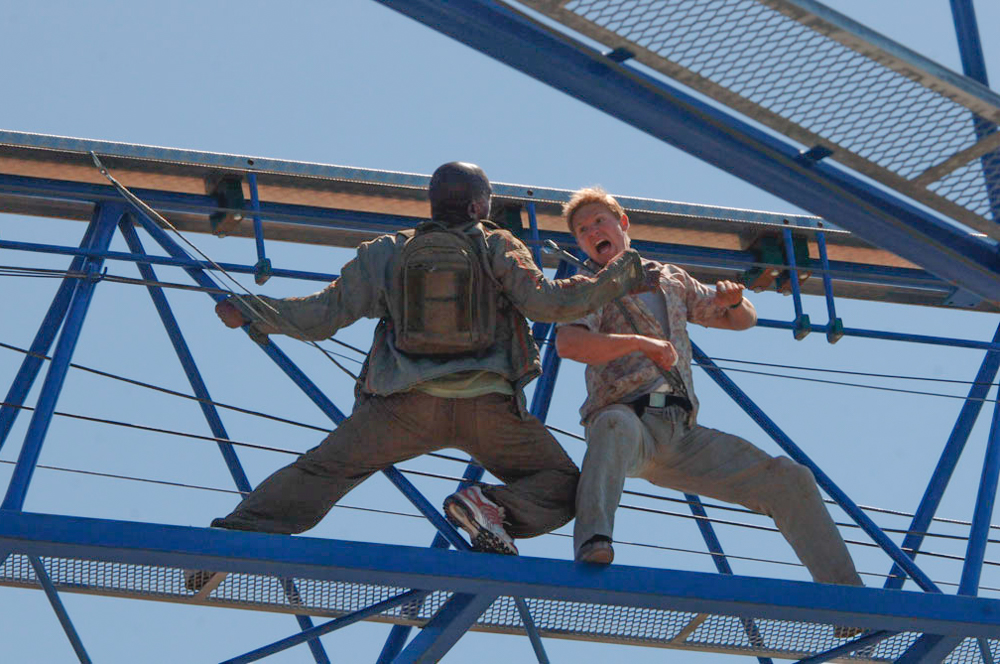
The last sequence with your character was the fight with James Bond in the air. I know that stuntmen from BJ Worth’s team were filming on location and you were filming in the studio with a mockup of the plane.

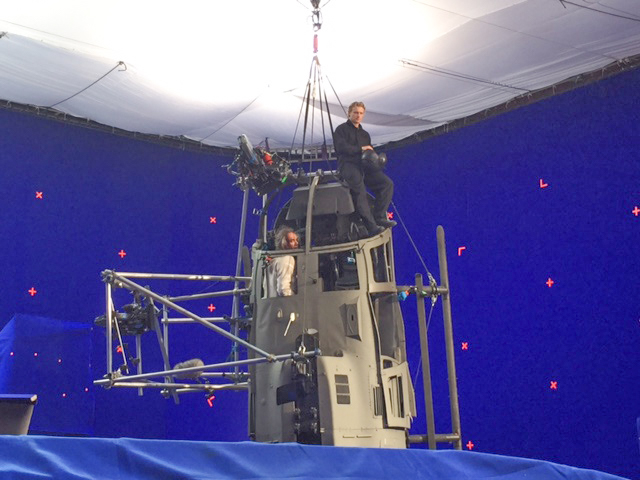
They shot the real stunt first. I did all other stunts in this film. Parachuting could be fun. I could learn this, but they didn’t let me do it. That was a good thing. When I saw it in the end I was glad I didn’t do it. It was crazy. They shot the real version first and then we did close ups in Pinewood. There was a mock up as you said. Half of an airplane was hanging there. They’d painted the total horizon and built a landscape from gypsum. Tim Dalton and I were hanging in the net in the air and we were getting down for each shot. In those days there was no non linear editing. Director John Glen had a cut on a Steenbeck and he was looking how to shoot close ups so they would be matching with what stunt guys did. It took three days to do that. That was slow process. That was the hardest work in the whole film because we were just hanging in the net for hours at a time.

So it was even harder than the fight?

Oh yes. The fight wasn’t hard work. You get a kick and then you get a break. That is no sweat. We were hanging in that net for an hours. There were harnesses and things like that so there was just no way to get out quickly. Waiting for the next take was not even comparable to the fight. Much harder work. I remember that we’d spent around an hour in the net and Tim said: ‘Dude, I’m wrecked already’ not knowing that we would be doing this for three days. That was far harder than any of the rest. That was in fact the only hard physical work that I recall. I was young, I was in good shape. I was a ballet dancer. Dancing is very hard physical work.

When was that sequence filmed?

It was filmed at the very end. The last day of that was the end for me.

You mentioned Timothy Dalton. How do you remember working with him?

I really appreciated Tim. I think he is a fabulous actor. I liked what he wanted to do with it, which was obviously important. I’ve been playing sort of smaller parts when you have to fit in what the leads are doing. He wanted to take it much more seriously than had been the case with Roger Moore. I appreciated that. Working with him was super professional. It was big movie making. It was filming until everything was as good as we could get. That was great.

How about the director John Glen. Did you have to stick precisely to his vision or you had a lot of artistic freedom?

He had some ideas that he wanted to see. There are always some things that you don’t know and you have to adjust to it because you will not see it until the day. The director can go and see the set or he can talk to actors and ask them to put on costumes but it doesn’t all come together really until the shoot. There is always some sort of leeway to make the most of it. Of course as an actor I like to have some ideas of my own. I tended to get those with the second unit which I sometimes worked with. The director was letting us to do a bit more stuff because if it didn’t work we just did it again with less stress than on the first unit.

Thank you for the meeting and for sharing with me your stories from the set of ‘The Living Daylights’.

November 26th 2020

Share this:

  • Click to share on X (Opens in new window) X
  • Click to share on Facebook (Opens in new window) Facebook
  • Click to share on Pocket (Opens in new window) Pocket
  • Click to share on Tumblr (Opens in new window) Tumblr
  • Click to share on Pinterest (Opens in new window) Pinterest
  • Click to share on Reddit (Opens in new window) Reddit
Like Loading...

‘The Living Daylights’ at Schönbrunn Palace in Vienna

22 Sunday Nov 2020

Posted by Piotr Zając in The Living Daylights, Vienna

≈ 1 Comment

Tags

Austria, filming location, James Bond, James Bond location, Schönbrunn Palace, The Living Daylights, Vienna

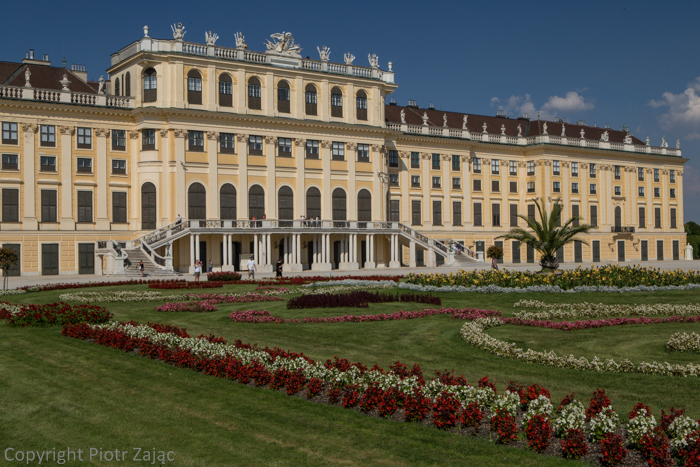
James Bond (Timothy Dalton) and Kara Milovy (Maryam d’Abo) arrived to Vienna and took a carriage to the hotel. On the way they passed among others Schönbrunn Palace, former summer residence of the Habsburg family.

Schönbrunn Palace in Wien, Austria
– Schönbrunn Palace.

The horse-drawn carriage with Bond and Kara traveled along a line of trees towards the southern facade of the palace.

Schönbrunn Palace in Wien, Austria
– Southern facade of the palace.

When they were passing in front of the palace an orchestra was playing on the balcony, and couples were waltzing on a stage.

Schönbrunn Palace in Wien, Austria

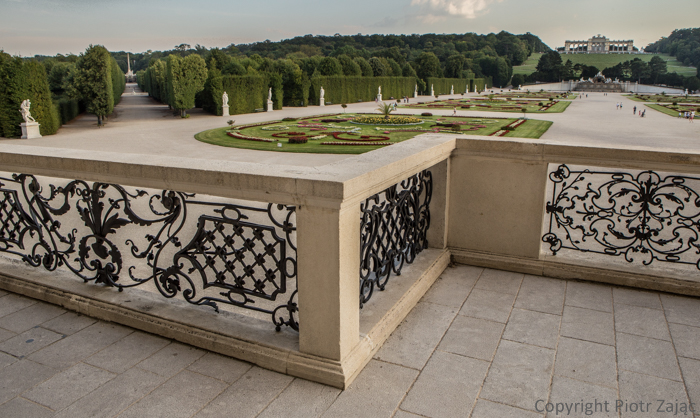
While visiting the Schönbrunn Palace you can enter the balcony where the orchestra was playing (see below).

Schönbrunn Palace in Wien, Austria

The stage where couples were waltzing was located below the balcony on a wide strip sprinkled with gravel that you can see in the next photo.

Schönbrunn Palace in Wien, Austria

Behind the carriage you could see the gloriette. It was built in 18th century on the top of the hill in the Schönbrunn Palace Garden.

Gloriette at Schönbrunn Palace in Wien, Austria
– The Gloriette on the top of the hill in the Schönbrunn Palace Garden.

Standing on the balcony where the orchestra was playing you can see on the left the alley that the carriage came along and the gloriette on the right.

Schönbrunn Palace in Wien, Austria

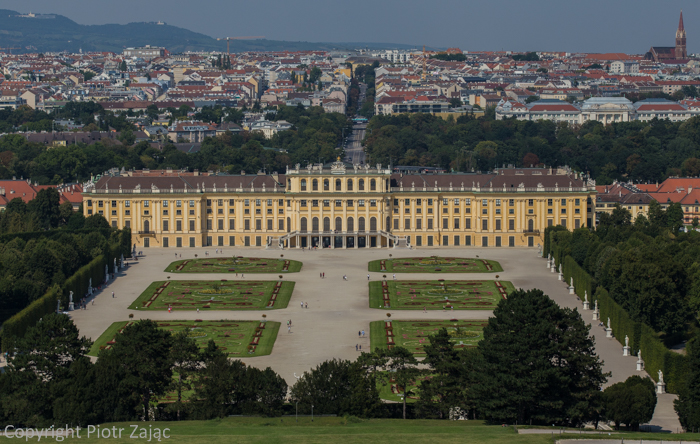
It is worth to climb the hill where the gloriette is located. The view from the top is gorgeous. You can see from there the southern facade of the palace with a city skyline in background.

Schönbrunn Palace in Wien, Austria
– View from the top of the hill in the Schönbrunn Palace Garden.

In the evening James Bond and Kara Milovy attended the opera performance. That sequence was filmed in Schlosstheater in Schönbrunn Palace with nearly 250 extras. It is worth to mention that Michael G. Wilson and his wife were sitting in the audience. As he confessed it was the charm of this place that convinced them to be part of the scene.

Schönbrunn Palace in Wien, Austria
– Schlosstheater in Schönbrunn Palace.

The same location was used for the concert sequence with Kara playing solo at the end of the film. The role of the conductor was played by composer John Barry, who composed soundtracks for 12 James Bond films. Unfortunately the Schlosstheater was closed for the public during my visit to Vienna.

The northern facade of the palace was the background for the end credits.

Schönbrunn Palace in Wien, Austria
– The northern facade of the Schönbrunn Palace.

Go to LOCATIONS GALLERY – ‘THE LIVING DAYLIGHTS’ to see photos of locations compared with movie scenes.

Information source:
– The Living Daylights Audio Commentary, The Living Daylights Special Edition, Danjaq, LLC and United Artists Corporation, 2006.

Share this:

  • Click to share on X (Opens in new window) X
  • Click to share on Facebook (Opens in new window) Facebook
  • Click to share on Pocket (Opens in new window) Pocket
  • Click to share on Tumblr (Opens in new window) Tumblr
  • Click to share on Pinterest (Opens in new window) Pinterest
  • Click to share on Reddit (Opens in new window) Reddit
Like Loading...

Article about my Bond travels for Collins Aerospace Wroclaw magazine

19 Monday Oct 2020

Posted by Piotr Zając in IN MEDIA

≈ Leave a comment

Tags

article, IN MEDIA, publication

This fall an article about my travels to James Bond locations was published in the magazine for Collins Aerospace Wroclaw employees.

Article about by Bond travels for Collins Aerospace Wroclaw magazine

Share this:

  • Click to share on X (Opens in new window) X
  • Click to share on Facebook (Opens in new window) Facebook
  • Click to share on Pocket (Opens in new window) Pocket
  • Click to share on Tumblr (Opens in new window) Tumblr
  • Click to share on Pinterest (Opens in new window) Pinterest
  • Click to share on Reddit (Opens in new window) Reddit
Like Loading...

‘The Living Daylights’ – locations gallery

10 Saturday Oct 2020

Posted by Piotr Zając in The Living Daylights, The Living Daylights

≈ 3 Comments

Tags

Austria, film travel, James Bond, James Bond filming location, James Bond location, james Bond locations, James Bond movie locations, James Bond travel, Prater, Schönbrunn Palace, travel, Vienna, Wiener Riesenrad

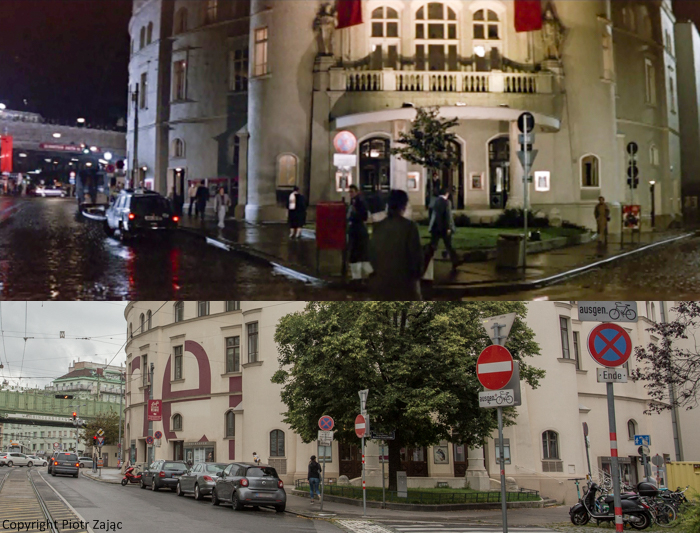
Real filming locations together with screens of scenes filmed in these places. Film scene on top and my location photo at the bottom.

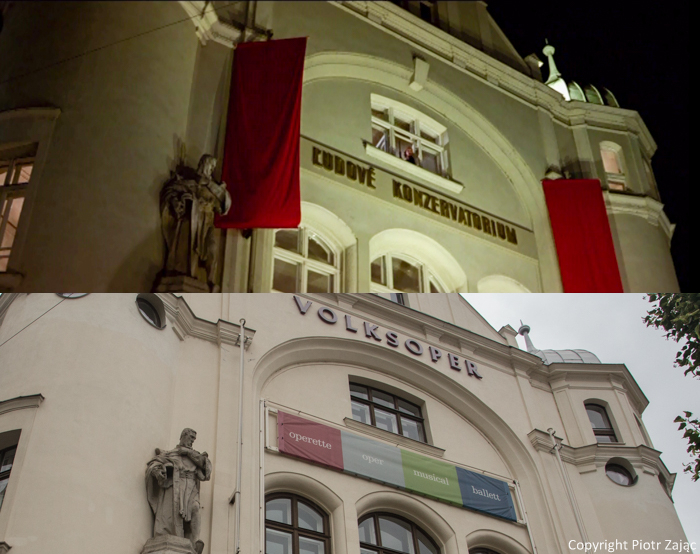
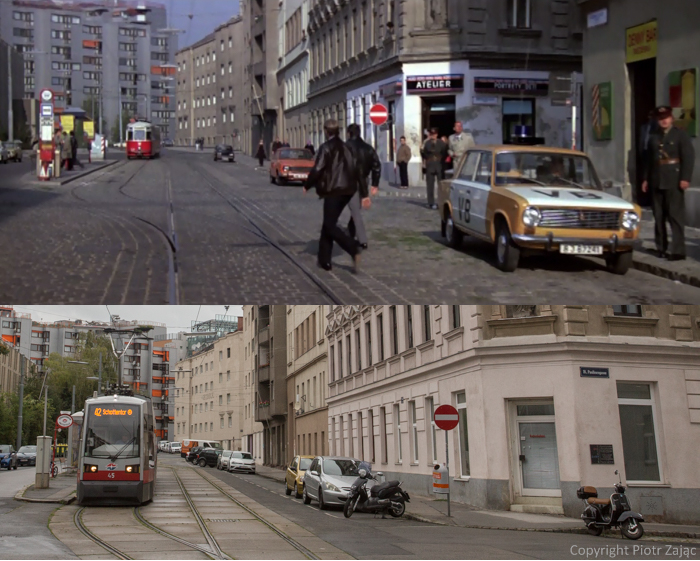
Währinger Strasse in Vienna, Austria– Währinger Strasse in Vienna, Austria. (location photo: 2020) Read the story behind the scene: Vienna as Bratislava in ‘The Living Daylights’.

Währinger Strasse in Vienna, Austria– Volksoper at Währinger Strasse in Vienna, Austria. (location photo: 2020) Read the story behind the scene: Vienna as Bratislava in ‘The Living Daylights’.

Währinger Strasse in Vienna, Austria.– Währinger Strasse in Vienna, Austria. (location photo: 2020) Read the story behind the scene: Vienna as Bratislava in ‘The Living Daylights’.

Volksoper in Vienna, Austria.– Volksoper at Währinger Strasse in Vienna, Austria. (location photo: 2020) Read the story behind the scene: Vienna as Bratislava in ‘The Living Daylights’.

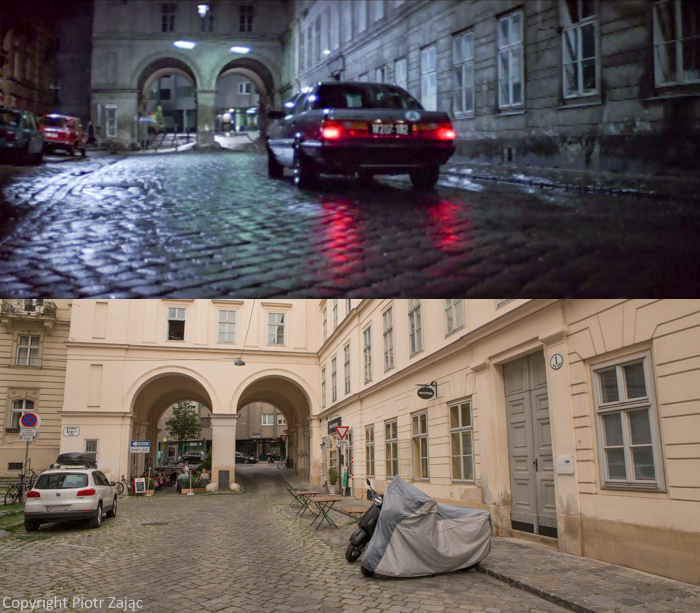
Traungasse in Vienna, Austria.– Traungasse in Vienna, Austria. (location photo: 2020) Read the story behind the scene: Vienna as Bratislava in ‘The Living Daylights’.

Traungasse in Vienna, Austria.– Traungasse in Vienna, Austria. (location photo: 2020) Read the story behind the scene: Vienna as Bratislava in ‘The Living Daylights’.

Doktor-Ignaz-Seipel-Platz in Vienna, Austria.– Doktor-Ignaz-Seipel-Platz in Vienna, Austria. (location photo: 2020) Read the story behind the scene: Vienna as Bratislava in ‘The Living Daylights’.

Antonigasse in Vienna, Austria.– Antonigasse in Vienna, Austria. (location photo: 2020) Read the story behind the scene: Vienna as Bratislava in ‘The Living Daylights’.

Antonigasse in Vienna, Austria.– Antonigasse in Vienna, Austria. (location photo: 2020) Read the story behind the scene: Vienna as Bratislava in ‘The Living Daylights’.

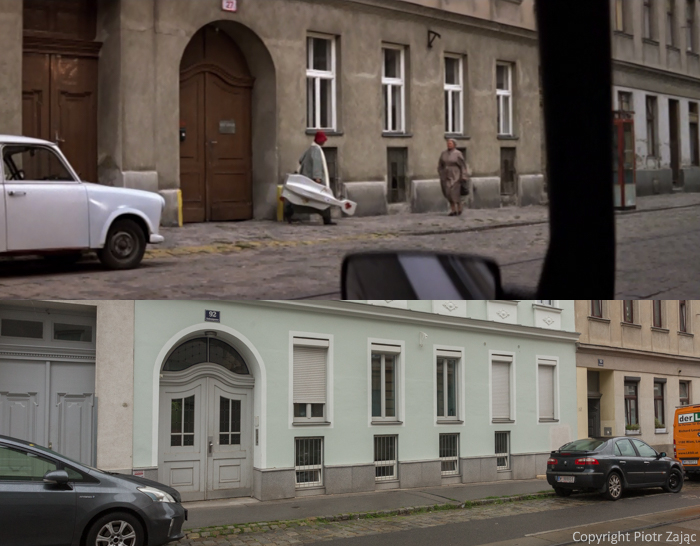
Antonigasse in Vienna, Austria.– James Bond leaving Kara’s house. It was filmed at Antonigasse in Vienna, Austria. (location photo: 2020) Read the story behind the scene: Vienna as Bratislava in ‘The Living Daylights’.

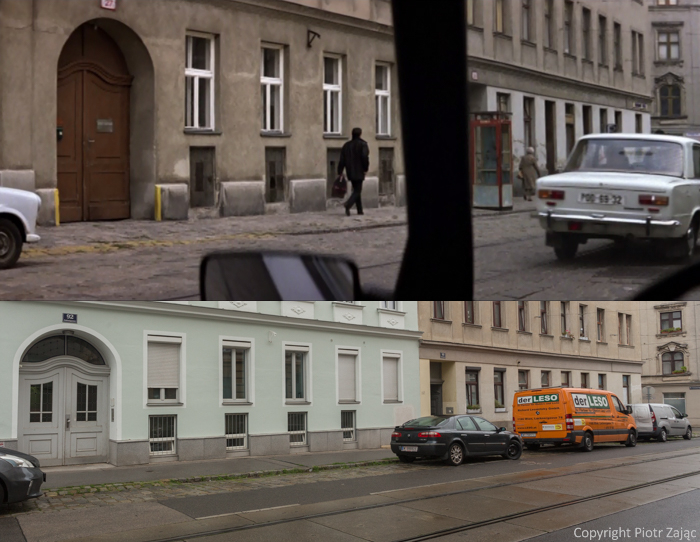
Antonigasse in Vienna, Austria.– Kara with the cello leaving her house. The house was filmed at Antonigasse 92 in Vienna, Austria. (location photo: 2020) Read the story behind the scene: Vienna as Bratislava in ‘The Living Daylights’.

Antonigasse in Vienna, Austria.– James Bond and Kara in Aston Martin drive past a telephone booth where the cello case pretending to be Kara was left. It was filmed at Antonigasse in Vienna, Austria. (location photo: 2020) Read the story behind the scene: Vienna as Bratislava in ‘The Living Daylights’.

Schlagergasse in Vienna, Austria.– James Bond and Kara driving away in Aston Martin. It was filmed at Schlagergasse in Vienna, Austria. (location photo: 2020) Read the story behind the scene: Vienna as Bratislava in ‘The Living Daylights’.

Prater in Wien, Austria– James Bond (Timothy Dalton) and Kara Milovy (Maryam d’Abo) arrive to Vienna in Austria. There is the Wiener Riesenrad in background. (location photo: 2020)

Maria-Theresien-Platz, Vienna, Austria

– James Bond (Timothy Dalton) and Kara Milovy (Maryam d’Abo) in a carriage at Maria-Theresien-Platz in Vienna in Austria. (location photo: 2020)

Schönbrunn Palace in Wien, Austria– Schönbrunn Palace in Vienna, Austria, in which direction James Bond (Timothy Dalton) and Kara Milovy (Maryam d’Abo) are heading in a carriage. (location photo: 2020) Read the story behind the scene: ‘The Living Daylights’ at Schönbrunn Palace in Vienna.

Schönbrunn Palace in Wien, Austria– End credits with Schönbrunn Palace in Vienna, Austria in background. (location photo: 2020) Read the story behind the scene: ‘The Living Daylights’ at Schönbrunn Palace in Vienna.

BACK TO LOCATIONS GALLERY

Share this:

  • Click to share on X (Opens in new window) X
  • Click to share on Facebook (Opens in new window) Facebook
  • Click to share on Pocket (Opens in new window) Pocket
  • Click to share on Tumblr (Opens in new window) Tumblr
  • Click to share on Pinterest (Opens in new window) Pinterest
  • Click to share on Reddit (Opens in new window) Reddit
Like Loading...

‘Moonraker’ – locations gallery

10 Saturday Oct 2020

Posted by Piotr Zając in Moonraker, Moonraker

≈ 3 Comments

Tags

Italy, James Bond, James Bond filming location, james Bond locations, James Bond movie locations, James Bond travel, Moonraker, Venice

Real filming locations together with screens of scenes filmed in these places. Film scene on top and my location photo at the bottom.

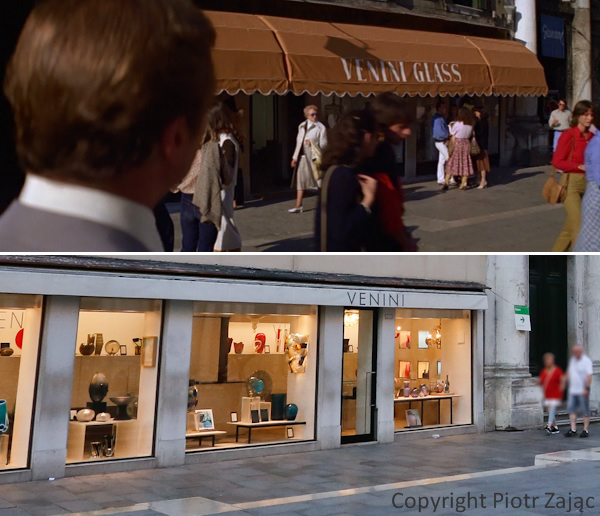
Venini shop at Piazzetta dei Leoncini in Venice, Italy
– Venini shop located at Piazzetta dei Leoncini next to Saint Mark’s Basilica in Venice, Italy. There was Venini Glass Works behind the shop that belonged to main opponent of 007 – Hugo Drax. Read the story behind the scene: ‘Moonraker’ in Venice. (location photo: 2019)
Venice, Italy
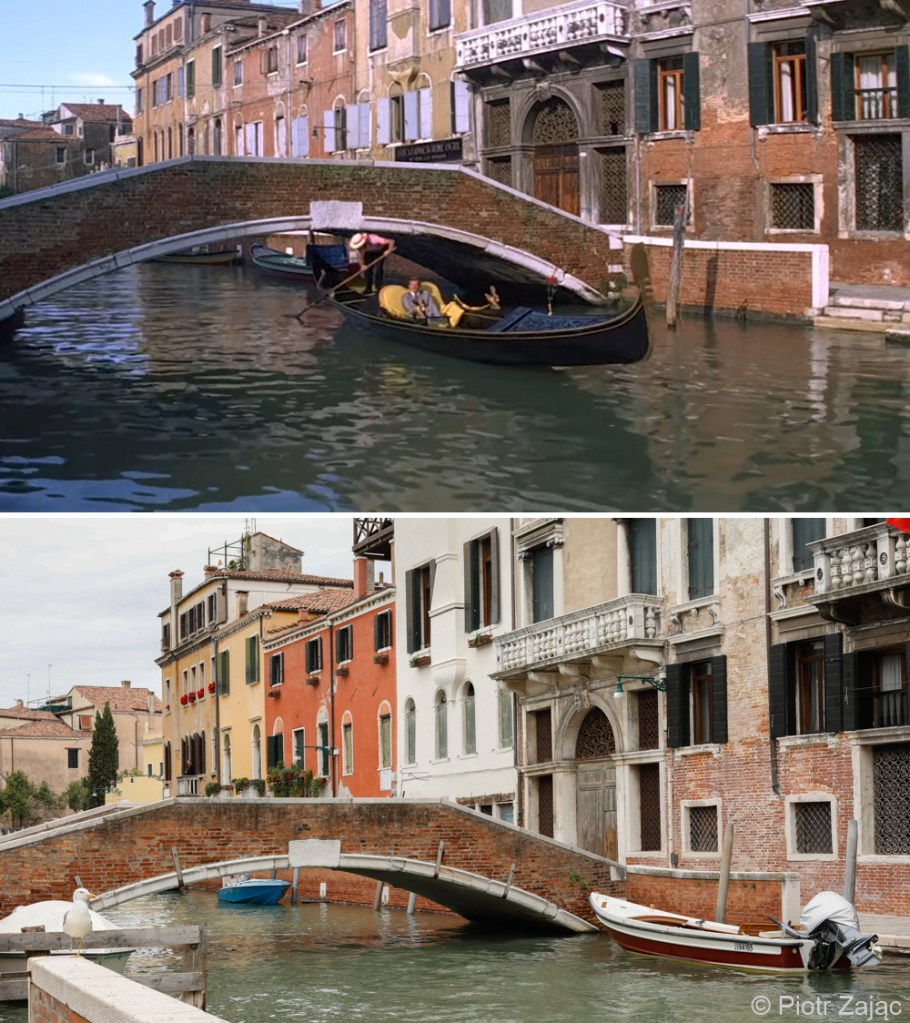
– Ponte Foscarini in Venice, Italy. (location photo: 2023)
Venice, Italy
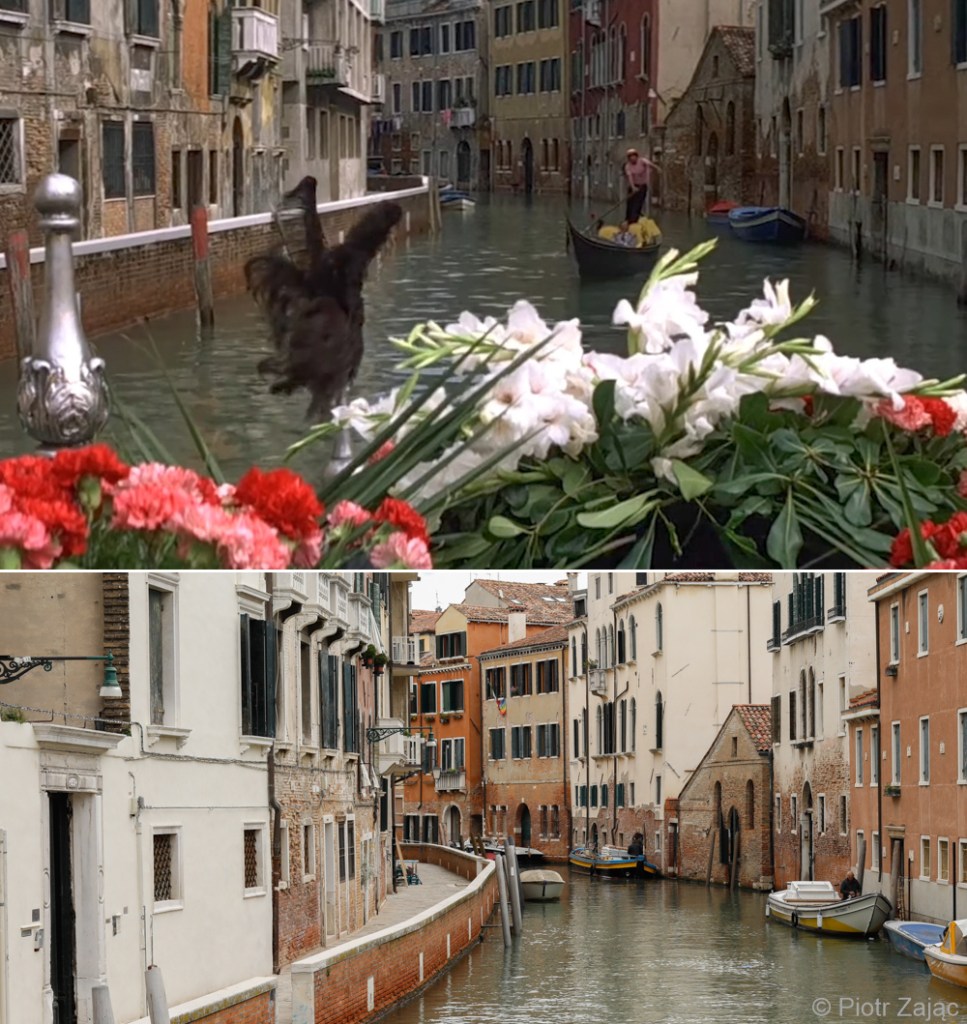
– Venice, Italy. (location photo: 2023)
Venice, Italy
– Venice, Italy. (location photo: 2023)
Canal Grande, Venice, Italy
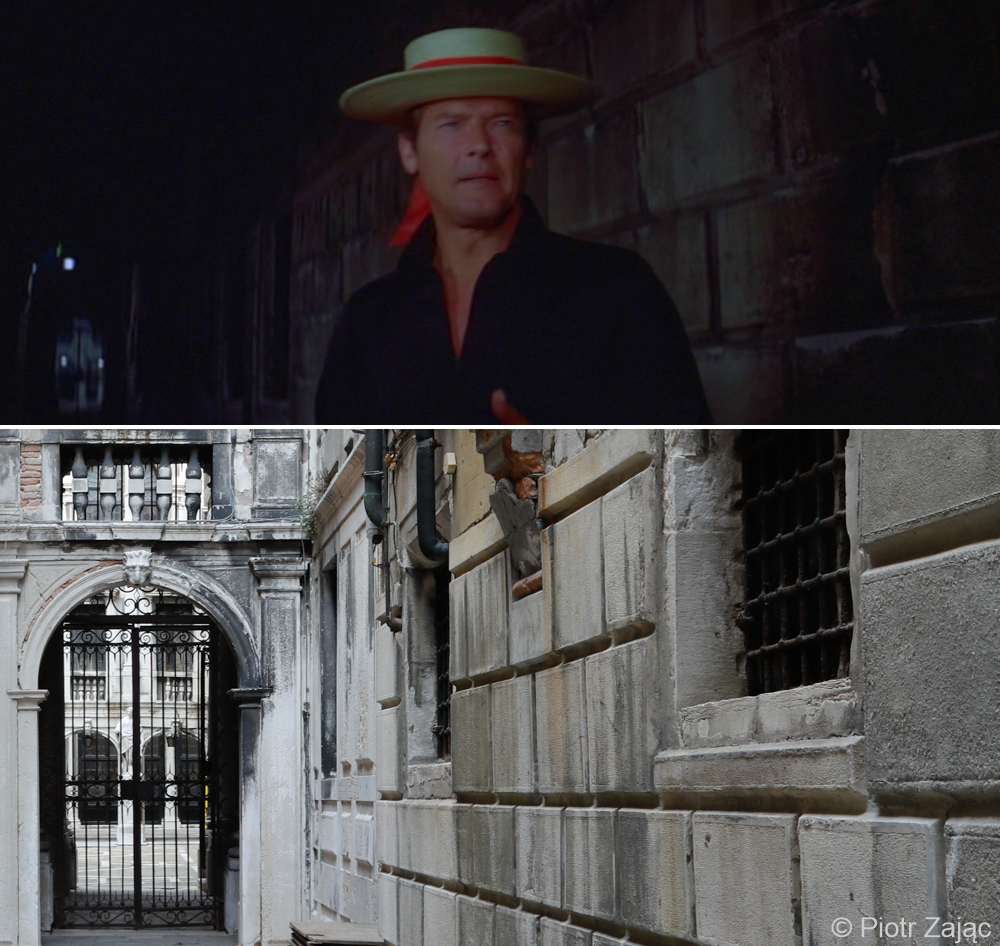
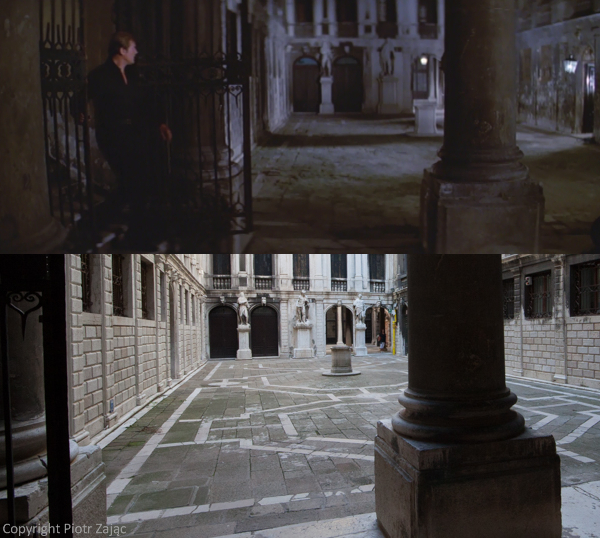
– James Bond moors a gondola behind the Palazzo Pisani to visit Drax’s laboratory at night. Read the story behind the scene: ‘Moonraker’ in Venice. (location photo: 2002)
Venice, Italy
– Entrance to Conservatorio di Musica Benedetto Marcello from Grand Canal in Venice, Italy. Read the story behind the scene: ‘Moonraker’ in Venice.. (location photo: 2023)
Conservatorio di Musica Benedetto Marcello in Venice, Italy
– Conservatorio di Musica Benedetto Marcello in Venice, Italy. Read the story behind the scene: ‘Moonraker’ in Venice.
Venice, Italy
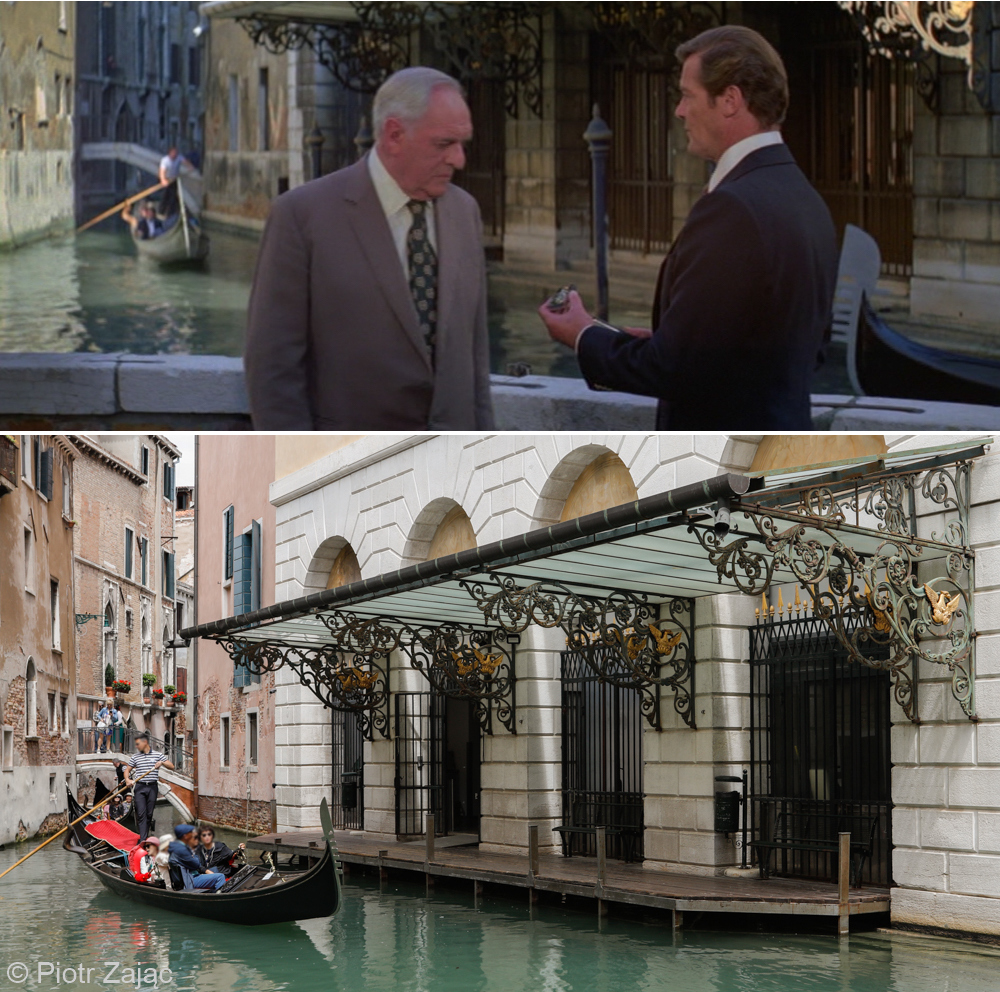
– Geoffrey Keen as Sir Frederick Gray, Bernard Lee as M and Roger Moore as James Bond on the Fondamenta della Fenice with Ponte Maria Callas in background. Venice, Italy. (location photo: 2023)
Venice, Italy
– Bernard Lee as M and Roger Moore as James Bond on the Fondamenta della Fenice with Fondamenta Maria Callas in background. Venice, Italy. (location photo: 2023)
Venice, Italy
– Bernard Lee as M and Roger Moore as James Bond on the Fondamenta della Fenice with Ponte Maria Callas in background. Venice, Italy. (location photo: 2023)

BACK TO LOCATIONS GALLERY

Share this:

  • Click to share on X (Opens in new window) X
  • Click to share on Facebook (Opens in new window) Facebook
  • Click to share on Pocket (Opens in new window) Pocket
  • Click to share on Tumblr (Opens in new window) Tumblr
  • Click to share on Pinterest (Opens in new window) Pinterest
  • Click to share on Reddit (Opens in new window) Reddit
Like Loading...

Interview with Marc Wolff – pilot who has worked on 12 Bond films

13 Sunday Sep 2020

Posted by Piotr Zając in A View to a Kill, Casino Royale, Die Another Day, For Your Eyes Only, Marc Wolff, Octopussy, Quantum of Solace, Skyfall, Spectre, The Living Daylights, The Spy Who Loved Me, The World Is Not Enough, Tomorrow Never Dies

≈ 1 Comment

Tags

A View to a Kill, Behind the Scenes, Casino Royale, Die Another Day, filming, For Your Eyes Only, interview, Marc Wolff, Octopussy, pilot, Quantum of Solace, Skyfall, Spectre, stuntman, The Living Daylights, The Spy Who Loved Me, The World Is Not Enough, Tomorrow Never Dies

Marc Wolff is a well-known aircrafts stunt pilot who has worked on many action movies including 12 Bond films. Find more on his official website www.marcwolff.net

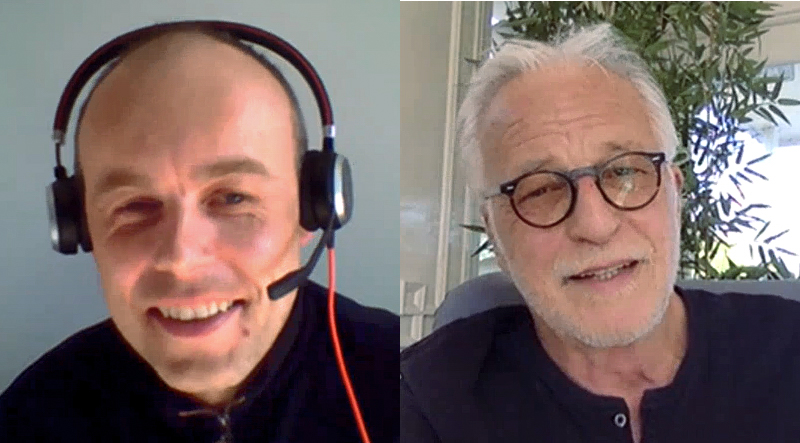
Piotr Zajac and Marc Wolff

Piotr Zajac (bondlocations): You’ve worked as pilot on 12 Bond films and also on the London 2012 Olympics Opening Ceremony with James Bond.

Marc Wolff: Yes. For the London Olympics we landed in the Queen’s garden at Buckingham Palace and also at Kensington Palace to shoot some interiors and close ups of the actors on the ground. We had a nice cup of tee in the palace.

Together with the Queen?

Not with the Queen, with her staff.

Your first James Bond movie was ‘The Spy Who Loved Me’. 007 was driving a white Lotus and you were chasing him in a Jet Ranger helicopter. How do you prepare for such a sequence? I guess it requires high precision.

Yes, it does but I think it also needs a good level of flying experience, especially of doing unusual types of flying work with helicopters. I was quite young then and although I had some experience and had flown helicopters for a year in Vietnam, I didn’t have a lot of film experience, so it was a new thing for me. I would prepare a bit different today than I did then. I had done a few little films starting in about 1974, we shot ‘The Spy Who Loved Me’ in 1976. I suppose I had been flying professionally for about 8 years at that point but nevertheless my film experience was limited. I didn’t really know what they wanted me to do until I got there. The big thing in those kind of situations is just to be careful and don’t make a drama out of something by having an accident. You need a good team of people around you watching what you are doing to make sure that you are doing it is safely. To give you a second opinion. I have a safety engineer, Stephen North, who I’ve worked since 1979. Stephen and I still work together today. He watches what I do and if he’s not happy he shouts at me.

There are many different types of aircrafts. I guess they are different also from the pilot perspective. I was wondering if the aircraft type in each movie is always determined already or you as a pilot have an influence on that decision?

For flying the camera I choose a helicopter with the right performance for the camera system they want to use, the number of people I need to carry and the location where I need to fly. If it is an action aircraft as in ‘The Spy Who Loved Me’ it is usually the director and the production designer who choose, with some input from me. For example on ‘Mission: Impossible – Fallout’ we looked at lots of different types of helicopters for Tom Cruise and the bad guy to fly. They liked the look of the EC 145 for the villain. In the case of Tom’s aircraft, they wanted to use a different type but I persuaded Tom that the aircraft that he eventually used was more robust and would be better suited for the kind of flying he wanted to do. I flew the bad guy helicopter rather than the camera helicopter for the main sequence although I flew a camera helicopter in the UK and Norway.

How do you prepare for a sequence with the helicopter so close to another object like the car in ‘The Spy Who Loved Me’?

You have to look at the locations and the clearance you have between the blades and the cliff, the car.  Everyday is a little bit different because the temperature as well as the wind speed and direction are different so you have to judge that each day on its merits. You have to look through the camera once the camera position is set up and see where you need to be in the frame and where the cars are going to be in the frame. You talk to the director and the cameraman about what action they want to see and then work out how to make that story point as exciting as you can.

Your next Bond movie was ‘For Your Eyes Only’. You worked on the opening sequence. I know that there were models and real aircrafts but it was difficult to recognize them.

‘For Your Eyes Only’ was made in the days before CGI. Even today when CGI is used, a lot things always look better if there is a real element somewhere. The viewer can see the weight of the aircraft, the light reflecting off it at different angles, etc. If there are a number of shots at the beginning of the sequence with the real helicopter, then with the shots that are not real become more believable. In that sequence a lot of it was real. We had real man getting out of the back of the helicopter and getting to the front seat outside along the skid.We flew a real man in a wheel chair on the end of the skid. We dropped a real wheel chair down the chimney. We flew a real helicopter in front of a foreground miniature for the scenes to make it look like we were ‘flying in the hangar’. So there were a lot of real elements that made the process shots, and the life-sized mockup, look believable.

In ‘Octopussy’ there were some aircrafts sequences like the opening sequence or final fight in the air. Were you one of the pilots?

In ‘Octopussy’ I flew a camera helicopter for the train sequence. The stuntman, Martin Grace,  was very badly injured because he was hanging outside of the train and he hit a post that was alongside the railway track.

To be honest I forgot that it was the sequence that required helicopter. Sometimes while watch the film I didn’t realize that the specific sequence was filmed from the aircraft. 

Sometimes that is the beauty of this, not to realise that the camera is in a helicopter. The camera helicopter is just another tool in a cameraman’s bag of tricks to get shots from different angles and different perspectives. Sometimes obviously you are showing an establishing shot like the establishing shot of Shanghai in ‘Skyfall’. It is quite obvious that it is an aerial shot. It sets the scene for 4 or 5 seconds to show you where you are in the world. But a lot of times we use an aerial camera on a helicopter to get an angle that is difficult with a crane, for example. Some other methods may be more time consuming and therefore more expensive so, surprisingly, it can be less expensive to use a helicopter.

In ‘A View to a Kill’ you were working on the opening sequence in Iceland.

I flew the Russian-looking helicopter that was searching for Bond. I flew that helicopter from Southend in Essex in the southeast of England up to the Shetland Islands and across the Atlantic Ocean to the Faroe Islands and then from there on to Iceland. That was quite a trip. And then back again. We painted the helicopter in England before we went to Iceland. It was painted to like a Russian helicopter with a big hammer and sickel logo on the side. Actually it was a German designed helicopter so it looked a little unusual (in other words, not American or French who are the main civil helicopter manufactures in those days). When we were flying across the North Atlandtic we came across some big Russian fishing trawlers in the middle of the ocean between the Faroe Islands and Iceland. We circled around and they all waved to us because they thought we were Russians because of the big Russian flag on the side of the helicopter (smiling). We waved back and wondered if they thought they were being spied on.. While we were in Iceland there was an eruption of a volcano. We got into the local newspapers because we helped to rescue some people that were standed up on a glacier.

 How long did it take to fly to Iceland?

It was a long, over-water journey for the helicopter. We had to put an extra fuel tank in the back of the helicopter cabin to be able to make the trip from the Shetland Islands to the Faroe Islands and from the Faroe Islands to the east coast in Iceland. It was a day’s flight (6 flying hours) from northern Scotland but it was long in terms of what that helicopter can do in one hop. We had a point of no return where we couldn’t turn back so our navigation system was important. It was in the days before GPS and we used a navigation system called Omega. We were about 50-100 miles north of the Shetland Islands and the system stopped working. We had a checklist of 10 things to check. My engineer Steve was reading off the checklist. Number 1 didn’t work, number 2 didn’t work and so on, we got to number 10 and it said: ‘change the unit’. (smiling) We had to decide if we could find the Faroe Islands on our own or if we should go back and change the unit. We turned around and went back to change the unit. We had to wait a bit in the Shetlands to get new unit from south of England. It was the safer option.

How do you remember working in Iceland.

There was a frozen lake with lots of icebergs at the bottom of a huge glacier. The icebergs were birthing, breaking off the glacier, and then floating around in this lake for several years until they melted small enough so they could get out of the lake over a sand bar and float out into the sea. We had to film among these icebergs. Every morning we started by flying a recce of the lake with the director Arthur Wooster. He was saying: ‘ This one looks good, we’ll go here, that one looks good too, we’ll go there’. Then we went back and landed and they took boats to go in amongst the to film. One day we were all sitting on an iceberg having lunch. The iceberg started to shift and tilt, becoming unstable; everybody had to get quickly into the boats and move away to a safe distance. It frightened everybody. Then, one day, they were filming close to the wall of the glacier where the icebergs broke off and almost got hit by one birthing. By the end of the film, on the early morning aerial recce, Arthur was saying: ‘I don’t like this one, I don’t like the look of that one’. Everyone had become very cautious.
We were stuck there for a couple of weeks in a fog because it was so cold there, it was like a microclimate. A lot of the area 10-15 miles away was clear and sunny but over the lake where we needed to film it was foggy. We had to wait for 10-14 days for this fog to clear. Everyone got bored standing around in the fog. We had a lot of styrofoam around. It was used as fake ice in the foreground of some shots The grips carved little horses out of these white pieces of styropfoam and we staged horse races. We tied a bit of string from the horse to a pole on a broom handle. There were like four horses and four people with strings on poles attached to the styrofoam horses. We had to wind up the strings with our hands. Whoever could wind up the string fast enough would get their horse across the finish line first. The grips ran a betting book and put odds on each contestant. So you could place a bet on who would win. Betting was illegal in Iceland in those days, so, of course, all the Icelanders loved it because they could bet on who who would win. That is how we kept ourselves sane during sitting in the fog.

In ‘A View to a Kill’ you were flying also around the Eiffel Tower in Paris.

That was quite a funny experience for me. I had a unique permission to fly in the centre of Paris but the permission required me to stay over the river Seine. The director wanted to relate the tower, the river, the city and the parachutist in one shot. The place the parachutist was supposed to land was between the tower and the river. To get a shot of the tower, the river, the parachutist’s landing site and the city of Paris in the background, I needed to be on the opposite side (the south side) of the tower, off the river, so I went around the back side of the tower to get the shot. When I landed back at the Paris heliport at Issy les Moulineaux, the police came and said that I did something called ‘bavarder’. I speak a bit of French and ‘bavarder’ means chatting or gossiping so at first I didn’t understand what they meant. I discovered it was slang and that I had ‘wandered’ off my permitted track when I went around the back side of the tower. He slapped me on the hand and said: ‘Don’t do it again’. Fortunately we didn’t need to do it again.

How do you prepare for such scene when the timing is very important?

The timing is critical. We talk about it in great detail; we discuss where the camera should be, and at what height, at each moment in the shot. So with the jump from the Eiffel Tower, I had to know how long he/she was going to free fall, how quickly the canopy would open and how long he/she would be under canopy. I knew the framing that they wanted for the opening frame so I had to work out the timing required to get from that position to the end-frame position within the timing the director wanted and the parachute gave us. When we have the opportunity to rehearse, we obviously do that. We always film the rehearsals because quite often it can be the best take. In this case we didn’t have such an opportunity. We just had to be in the right place at the right time, which is why they bring in someone like me rather than using a local pilot. I’ve got the experience and skill and the best chance of of getting it right first time. The Opening Ceremony of the London Olympics in 2012 was a good example of that. We had a two-minute, final run-in to get to the point where the 2 parachutists could jump from the helicopter into the stadium. We had marks that we would try to hit 3 or 4 times during that two minutes; marks for when the television cameras would see us, marks for when the audience would see us, marks for the parachutists which depended on the wind speed and direction. We were not hitting these marks accurately enough. We would finish our rehearsals at around 9:30 at night, land the helicopter back at our base, drive to the Olympic stadium, go up to the conference room and sit around a table with 50 people at until one o’clock in the morning. Everyone had their opinion why the timing wasn’t working. We were using a very sophisticated helicopter that, in theory, could do everything automatically. The Olympic Committee was given the helicopter, an Agusta-Westland 139, free-of-charge, by the manufacturer in turn for the publicity. I was sent to Italy for a month to learn to fly it. We used 2 two pilots for safety. I was assigned to fly with a very experienced test pilot from the factory who knew the aircraft intimately. I spent six months with him, planning, training and testing the jumps from different heights, making sure the special, quick-opening parachute would open safely under the helicopter and insuring that we could hit the target landing area accurately, from different heights, and in varying wind conditions. We did over a hundred test jumps before we actually came to that hero night. In the end, even on the last day at 5 o’clock in the afternoon, a couple of hours before the beginning of the ceremony, we were still rehearsing because we had a new, northerly wind direction, different than any we had had on any of the previous rehearsal days at the stadium which meant we needed a whole new set of marks. The test pilot wanted me to use the computer in the helicopter to get the timing. I tried it this way but it wasn’t accurate enough. At the end of the day it was my responsibility to deliver what Danny Boyle wanted so over a cup of tea in the afternoon I had to say: ‘Look, I’ve got to do this my way, visually’. ‘You have to help; you can’t tell me: I’m going to be early or late to my mark. You’ve got to tell me exactly how many seconds I have left. Tell me I’m 45 seconds away from checkpoint 007 or I’m 30 seconds or 10 seconds. I’ve worked this way all my life, with your help, I’ll hit that mark if I know how much time I have left until I get there and I’ll be more accurate than the computer’. The same applied to our height which was critical for the parachutists. The last week or ten days we were doing live rehearsals at the stadium, sometimes with an audience, sometimes without, but we never did the actual jumps into the stadium with the crowd there so as not to give the game away. In the end I did it visually and the one time we got it perfect was the one that counted, that last jump on the hero night at 9:30 pm on the 29th of July 2012.

But you did it.

We did it, finally. (smiling) It was a team effort and a big relief to have achieved it. Everyone was saying: ‘You must be very high’. I said, ‘no, I was just relieved’. It was big weight off my shoulders.

What about the sequence at the Golden Gate in San Francisco? Did you work on that as well?

I flew the camera helicopter. We filmed background plates in San Francisco. It was great fun to fly around this famous bridge. My father, who was a civil engineer, had worked on the design of the other big bridge there, the San Francisco-Oakland Bay Bridge.

Then you worked on ‘The Living Daylights’. There was a fight in a Hercules aircraft (click here to watch the sequence). I know that part of that sequence was filmed in the studio.

We also did some live action filming at Quarazate Airport in Morocco and in the air over the desert nearby. I was flying in the Moroccan Air Force Hercules coordinating the aerial stunt sequence. There was a stunt crew at the back of the Hercules performing a fight scene on the open, ramp door and a cargo net which was flapping behind it in the wind. We had a camera airplane flying in formation alongside us filming the fight. The cockpit of the Hercules is like a big office so I could move around, look back into the cargo area at the fight and lean in between the two pilots and look out through the windows at the camera plane and talk to the director and camera crew on the radio. They could cue me when they wanted certain things to happen which I would then relay to the Hercules pilots and the stunt crew. In the sequence Kara Milovy was meant to be flying the airplane and Bond was fighting at the back on the open, cargo-door ramp. Bond was shouting to her to close the ramp door. She was playing with the levers in the cockpit trying to sort out which switch operated the ramp door. Instead of closing the ramp door, first she shut one of the engines down by mistake, then she made the flaps go down, then the landing gear, Bond was getting more and more frustrated, eventually she found the right lever to close the door at the back. It was quite humorous in the cockpit. The Moroccan Air Force were trained in the USA because the Hercules was an American aircraft so they all learned to speak English, they also spoke very good French and obviously Arabic, which was their native tongue. I was standing behind the pilots coordinating on the radio between the camera airplane and the Hercules. The Hercules has 4 engines. The engine that the director wanted to shut down, from the camera point of view, was the engine which powered the main hydraulic pump. The hydraulics control the operation of the the landing gear, the flaps and the ramp door. Because that engine was shut down, they had to use the auxiliary hydraulic motor which was driven by one of the other engines. The auxillary hydraulic pump wasn’t as powerful as the main pump and it began to overheat after several takes of this chaos. The flight engineer, who was sitting behind me, kept complaining to the pilots: ’The pump is getting very hot! It is getting very hot!’. They were all arguing. At first they were speaking in English in a very polite way, then they started arguing a bit and switched to French. I speak French so I could still understand what they were saying. When the conversation heated up and they started to speak in Arabic I knew it was time to shut up, stop asking them to do things, sit down in my seat and put my seat belt on. (smiling) At the weekend on our day off, I was invited to a barbeque with all the Air Force crew and pilots. The engineer was cooking. All the pilots were giving him a hard time saying: ‘No, no, watch out, the fire is getting too hot, you are overheating the meat’. They were getting their revenge and teasing him because he had been giving them a hard time about the over heating hydraulic pump during the filming.

I’ve seen a documentary about your work on ‘Tomorrow Never Dies’ called ‘Shoot to Thrill – The Marc Wolff Story’. It was very impressive, especially the opening sequence in the air with the dog fight between 2 jet fighters.

I flew the camera jet and a camera helicopter and coordinated the flying aspects of the sequence. The two jets in the story were Aero L-39 Albatrosses designed and built in the Czech Republic. The camera jet was a French Corvette, business jet. Inside the Corvette we fitted a camera system with a periscope that went down through the belly of the Corvette. It was operated by Adam Dale, the aerial cameraman, and could look 360 degrees in all directions. Flying with us was the 2nd unit director, Vic Armstrong. We shot the sequence in the Pyrenees south of Toulouse. We used a helicopter when we wanted to have a static platform in the air and see the jets whizz by.

How do you prepare for such sequence when you fly so close together. Do you work with your team?

That was probably one of the biggest Bond jobs for me. I can’t remember how many months I worked on that, but it was a long time when you count the prep time to organise the jets and find the flying locations. Unlike ‘The Spy Who Loved Me’ when I came out and knew nothing about what I was going to do until I arrived, on ‘Tomorrow Never Dies’ I was given a lot of time to prepare for this sequence. This was in part because of my previous relationship with the director, Roger Spottiswood. I chose the airplanes, I cast the stunt pilots who were to fly the L-39s, Mark Hanna and Rolf Meum. I went to the Czech Republic to look at the airplanes and make sure they had the right performance and make sure they could land and take off at that tiny little airstrip at Peyrousoude in the Pyrenees.

How did you manage to use military aircrafts on film set?

Those aircrafts came from the factory in Czech Republic that made them. These were aircrafts that were used by various military forces, but they were civilian aircrafts from the manufacturer. Part of my job was to get permission to bring them into France, to operate them there, to fly them close to the mountains and to get permission for my pilot to fly as a co-pilot. They were two seaters with one seat in front of the other. I had one pilot from the factory and one of my pilots who was used to do a formation flying and worked in films. I flew as a co-pilot in a camera jet which came from the company that was based in Toulouse and did a lot of aerial filming for Airbus, which has big factory near Toulouse. We used their camera system. I did the formation flying and they landed it and took it off from the airport. They were there in case of some emergency because I didn’t know the airplane very well, but I knew how to fly in formation.

How long did it take to film that sequence?

We had several months of preparation and I imagine we were there for a few weeks.

I guess it was difficult to film that sequence. I think it is worth to undestand the whole effort behind such scenes, especially nowadays when viewers got used to CGI and may not see how brilliant it really was.

This was sort of pre-CGI too. Most of it was real. The missiles that fire and explode on the cliff face were CGI obviously but all the flying was real. I remember filming the navy frigate sailing at sea as an establishing shot before they cut inside to the control room. In the storyboard we had a picture with no horizon and a drawing of the ship at sea. The ship was about an eighth of the frame. I was being sent down to Plymouth with my cameraman, Adam Dale, to shoot it. I asked the director, Roger Spottiswoode: ‘Do you want this exact composition from storyboard’? You need to be careful with storyboards. If you’re gonna film for Steven Spielberg or Ridley Scott, they will give you the storyboard and you need to come back with that exact framing. They have a very specific idea how the shots should look: the composition and how many seconds the move should be. In this case Roger said: ‘This storyboard is just to show the producers and the studio that we will have a shot of a ship here. Just get me an interesting and exciting establishing shot of the ship’. We were filming in the English channel with the ship sailing southwest into the wind and the big sea, travelling as fast as it could so the big waves crashed over the bow. We were flying downwind, in the opposite direction, straight towards the bow of the ship. We did a take flying as low as we could, and fast, about 3 feet above the sea, trying not to hit the waves. There were big swells and steep waves. The Frigate was going as fast as it could, 20-25 knots, and we were flying at about 100 knots towards it in the opposite direction. We had a gyrosablised camera system mounted on the nose of the helicopter. At the last possible moment we pulled up over the bow of the frigate and continued climbing over the bridge and then the mast, tilting down the camera as the mast came through frame. At that point the were going to cut to a shot inside the control room of the frigate. So that was the shot we gave them and it couldn’t have been more different from the original storyboard. The timing of the move was critical. We were on a wide angle lens to show the scale of where we were at sea but that meant we needed to be really close to the ship to feel its size, weight and power. We did quite a lot of takes of it, getting closer and closer each time. I wanted to keep the ship sailing in the same direction, ploughing into the heavy seas and was wondering how long it would be before they had to turnaround so as not to get too far from Plymouth. I radioed the captain as asked him, ‘How long can you keep going in this direction? Do we have to turn you around and move you back?’ He said: ‘I can keep going until I hit the east coast of America’. (smiling) That was enough for us.

In ‘Tomorrow Never Dies’ you were also filming motorbike chase.

They were going to film that in the Republic of Vietnam. At the last minute they changed the location to Thailand. I had worked in Thailand a few times, on Air America and Good Morning Vietnam and my daughter, Lily, was born there in Chaing Mai when we were shooting Air America. We were based in Bangkok on Tomorrow Never Dies and also shot down in the south in the islands near Phuket. In Bangkok the hotel was on the river and the 2 helicopters were based at a heliport that was also on the river. We used to commute to work in a long-tail boat, avoiding the terrible Bangkok traffic. It was great fun. We would meet up on location and walk over the roof tops with Vic Armstrong and the second unit team. He would talk us through the shots, showing us where the ground camera positions would be and where he wanted the action helicopter and the camera helicopter. My camera assistant, John Marzano, ended up being one of the gunners in the helicopter. The gunners had to be careful because the guns fired real blanks and we needed to make sure the spent cartridges didn’t go into the engine intake or hit the rotor blades, especially the ones at the tail. The scene with the motorbike jumping over the top of the helicopter was filmed in the studio. Pinewood was busy, so they built the rooftop set in an old aircraft factory in Radlett, north of London. The helicopter was a life-sized mockup mounted on a hydraulic rig and track. I flew a camera helicopter there.

In ‘The World Is Not Enough’ you were filming the boat chase on the Thames in London.

That was quite fun too. Normally you have to stay 1000 feet above the river. Sometimes you can get permissive on to go down to 500 feet or even a bit lower. We wanted to fly 20 feet above the river. To do that we had to put a number of special safety precautions in place: stop all the traffic on the river, close the bridges that we wanted to fly over, provide a safety boat with divers, and keep 3rd parties and the public well away. We had to make sure that the Parliament wasn’t in session so we wouldn’t disturb their debates. We flew very, very low down the river chasing the boat. The bridges were closed to the public but we had our stunt doubles walking across the bridge and a few cars crossing over so the location looked alive and real. We were flying at the height of lamp posts on the bridge or between lamp posts even.

There was another interesting location in London above which you were flying – Buckingham Palace in ‘Die Another Day’.

That was quite complicated because the height we had to get for the parachutists had to be about 2500 feet. Normally we were not allowed to fly in that area over the palace, and not higher than 1000 feet because of the air traffic going into Heathrow Airport. To give us permission to go to 3000 feet they had to divert the aircrafts, so there was a lot of coordination required to organise and film that sequence.

In this film you were also filming a car chase on a frozen lake in Iceland.

It was the first time I’ve ever seen the northern lights, because we shot that in the winter when the lake was frozen. I think it was in February.

How did you prepare for such sequence to coordinate cars and camera?

In that kind of thing we did a lot of rehearsals to get the camera in the right place, passing between the icebergs. Getting different sizes: big wides to show the beautiful location but also getting close to the car to show its speed and who was in it.

Who decides about the focal length of the camera lens for each scene?

There is the director, a director of photography and then, in the helicopter, an aerial cameraman. We transmit the camera image from the camera down to the ground so that the director can see what we are filming live. This allows him to tweak the shot if he wants. So it is a combination of all of them. Usually in the camera helicopter we have a zoom lens so we can go from 25mm to 250mm or something like that. Sometimes we put doublers on the lens to get closer, but in the sequence like that we can get very close to the car. We can get the lens 5 feet away from the car depending on how much it is manoeuvring. If the car is spinning or weaving about then we need to leave it some space. We can get very close to it because we are not endangering others there, especially members of the public. We only have us and the stunt driver to be careful about, sometimes there are also camera crew on the ice we need to look out for. We rehearsed it and we knew what the cars were going to do and they knew what we were going to do.

From cold Iceland you moved to warm Bahamas where you were filming opening sequence for ‘Casino Royale’?

There were wide shots to show the whole geography and close framing to show them running on the top of cranes. I provided the crew and helicopter equipment but I didn’t fly on this location because I was on another film at the time.

But you were filming the establishing shot of the yacht sailing to Venice.

Yes, I had flown in Venice a number of times. It is prohibited to fly low over the old city but I was over the water that was empty except for some boats so I thought I was fine. I was fying so low that little water taxis had to get out of my way, about 3 feet above the water. This enabled us to see the yacht and the cast while also framing the city in the background. Next morning I was told that I had a call from aviation authority. I had to ring the head of the Italian Civil Aviation Authority at Venice airport. He said: ‘Mr. Wolff, before you say anything, I have a picture of your helicopter filming the yacht on front page of the local newspaper. You were supposed to be 300 meters high but it looks like you were 3 meters high’. Actually I was a little bit lower than 3 meters. (smiling) So I got what we call in Britain, a bollocking. I was told not to do that again.

You were also flying very low over Garda lake when filming establishing shot for the opening scene of ‘Quantum of Solace’.

That was an interesting one. We were flying as low as we could over the water. Second unit director Dan Bradley said: ‘Is that as low as you can go?’ I circled around and said: ‘Look’. You could see that the back end of the skids had left a trail in the water because they were dragging along the surface. When you are flying at the certain speed the nose is a little bit higher. The back end of the two skids had dragged into the water and had left their mark. I said: ‘Dan, I don’t think we can get any lower, unless we become a submarine’. (smiling)

Were you also filming the car chase along the lake?

Yes. Then we did some filming in Italy for the sequence with Daniel Craig coming to Talamone. Establishing shot of the boat. They wanted us to start very close to the boat so we could see Daniel. I’d worked with Daniel a few times by then. I did ‘Layer Cake’ with him. He was always very nice to me. But he got a bit angry there because I put a little bit of spray on him. I was a little bit too close. It is always difficult because you don’t want to see that the helicopter is there and you don’t want to spray the water into the camera or the frame, but sometimes you want to get as close as you can, so you get closer and closer and you may be too close. So I got a message back: ‘Daniel is not very happy, you sprayed him with water’. I said: ‘Sorry. We won’t come so close next time’. (smiling)

You were also working on ‘Skyfall’. How do you remember working with the director?

Sam Mendes is obviously a wonderful director. He had a vision of the shots he wanted but sometimes needed to tweak them once he saw them for real. Another aerial unit had been sent to Scotland to film James Bond driving along the road on his way to the Skyfall house. Sam wasn’t very happy with what he saw. In fact, what he wanted was there but they had shot so much material that he got fed up watching stuff he hadn’t asked for. Usually when you do these things you shoot what the director wants first and then if you have another idea you want him to see, you shoot it later. I had to go to to a big meeting in Istambul in Turkey to make sure that these things wouldn’t happen again. That was because I was going to film on my own, without another director, the shot with the yacht at sea with Bond and the girl going to an island where the villain was located. We filmed the shot the Sam had described that he wanted. The director sometimes visualises these things but he doesn’t know exactly what he likes or if it works, until he sees it. The second unit had to go back end re-shoot some scenes because he didn’t like what he got. Anyway we did the shot of a boat approaching the island. The boat was sailing in the right direction for the light, there was a clear horizon, it was the right time of day for the light, it was the move he asked for, but I was worried that it didn’t feel right and that when Sam saw it he might not like it. We did it 2 or 3 times until we were happy with the take. It was exactly what he’d asked for. I said to Greg Wilson, the executive producer, who was with me: ‘I think we’ve got what Sam asked for Greg. Are you happy?’ Greg said ‘Yes’. I also said: ‘I think we should give Sam a couple of other options in case he might like them better’. After all, we were there, the yacht was there, the weather was good, it would be less expensive to shoot some more versions now than come back the next day if Sam didn’t like what he saw. So we did a couple of these other moves. Greg liked them and thought they were nicer but it was Sam’s choice, obviously. We finished the shooting, the sun went down and then we’ve set up a live link to Sam in Instanbul, show it to him at the end of his day. After seeing the first few takes he was not happy. I said: ‘We did a couple of other things, have a look and see. You might like them better’. He looked at the stuff that we shot later and he was very happy with that. So we wrapped and went home.

Were you filming also the final fight sequence with the helicopter attacking the Skyfall mansion?

Yes, I flew the camera helicopter.

Your last Bond movie so far was ‘Spectre’. Were you involved somehow in filming the opening sequence in Mexico?

I did some consultancy work on that sequence but I didn’t go to Mexico. I filmed the train sequence in Morocco with the camera helicopter.

You also filmed the final sequence with boat chase in London. Similar to ‘The World is not Enough’ you were flying above the Thames.

Yes I did. It was a night shoot. We made a temporary heliport next to Vauxhaull Bridge where we could land the action helicopter because we wanted it to be close to the set. The light was quite critical and we didn’t want to waste time flying back and forth to the refuelling site which was 10 minutes away outside of London. We got a very unusual permission to land on a very small bit of ground right on the edge of the river in a little paved area, the size of a postage stamp. It was close to Vauxhall Bridge and opposite the MI6 building which features in the sequence. Being based here allowed us to be very efficient. We had to close a lot of roads, three bridges and the Thames river to traffic to protect the public. There was a lot of disruption to traffic in the centre of London even though it was in the middle of the night. We wanted to minimise that disturbance and the noise much as possible. Like in ‘The World is Not Enough’ this shoot involved a lot of organization and meetings with the authorities for me. I flew the camera helicopter, I cast the pilot who flew the hero aircraft; a pilot with the right personality and skill level. I found a hero helicopter that had the right look for the production designer and Sam Mendes but one I knew came from a company that would be helpful. A lot of these bigger helicopters are flown by people that don’t do unusual flying. I needed a pilot who would be flexible enough to work the unusual, long hours as we do in filming and to do the flying he had to do in that sequence with a certain amount of panache. I was lucky I found a helicopter that they were happy with and a pilot I was happy with.

You didn’t work on ‘No Time to Die’, but you’ve worked as second unit director on ‘Bohemian Rhapsody’ with Rami Malek who played the villain in the latest Bond movie.

I directed a short sequence on Bohemian on the additional photography unit. After the film was finished, it was audience tested and reviewed. The producers decided that some additional material was needed. Bryan Singer had directed the sequences for the Live Aid concert at Wembley early in the schedule. There was a lot of energy and it was very good. Dexter Fletcher, who finished directing the film after Bryan Singer had left, was doing the additional photography but he was also in prep for ‘Rocketman’. They needed a DGA director to replace him. The DGA is the American directors union. (Directors Guild of America) They couldn’t film the cast on stage without a union director on the set. The production manager knew that I had a DGA ticket and I had worked with Dexter on couple of films before so he new me. They rang me and asked if I could do it. I had just had surgery on my knee, the day before so I was walking with crutches. They called and asked me if I could work for them the next day. I said: ‘yes for sure’. What do you want me to do?’ They said: ‘There isn’t much to do because the cast have been together for months’. At the real Live Aid concert the band hadn’t been together for a couple of years. They needed some scenes of them being a little more tentative and a little bit unsure of themselves at first, before the old magic kicked in. That was half of my day. I also did a pub scene with people siting around drinking and talking, at first not paying much attention to the music until Queen came on stage. By the end of their set everyone in the pub was up dancing and rocking to the music. Queen’s performance at Live Aid is still rated as the best ever gig of that nature.

Do you think that Rami Malek will be good as a villain in ‘No Time to Die’?

He has got that Bond villain face. They always cast people with a special look and I think Rami has it. Woody Allen says: ‘If I cast the film correctly I don’t have to worry about directing the actors.

June 1st 2020
Share this:

  • Click to share on X (Opens in new window) X
  • Click to share on Facebook (Opens in new window) Facebook
  • Click to share on Pocket (Opens in new window) Pocket
  • Click to share on Tumblr (Opens in new window) Tumblr
  • Click to share on Pinterest (Opens in new window) Pinterest
  • Click to share on Reddit (Opens in new window) Reddit
Like Loading...

Interview with Bobby Holland Hanton – stuntman who has played in 3 James Bond films

01 Wednesday Jul 2020

Posted by Piotr Zając in Bobby Holland Hanton, Quantum of Solace, Skyfall, Spectre

≈ 1 Comment

Tags

Bobby Holland Hanton, interview, Quantum of Solace, Skyfall, Spectre, stunt double, stuntman

Bobby Holland Hanton has been professional stuntman for over a decade. His career began on the set of ‘Quantum of Solace’. Since then he has worked on number of movie hits. Find them all on his website.

Piotr Zajac and Bobby Hanton
During an interview with Bobby Holland Hanton

Piotr Zajac (bondlocations): You have started your career as stuntmen in film industry from James Bond film – ‘Quantum of Solace’. How do you remember that time?

Bobby Holland Hanton: To jump into high level and work with such a great team, great stunt coordinator and learn very fast on my feet was a great experience. I’ve kind of used that throughout my career today.

How did you get to ‘Quantum of Solace’?

I went for the audition. I had a couple of meetings with the team. I had some photos taken showing my stunt reel at the time. Then I had a couple of physical auditions. It was a process of about five auditions. I got a call to come in and stunt double for James Bond. I think originally it was for five weeks and ended up being six months. Gary Powell, the stunt coordinator, kept me on for the whole show and I ended up doing a lot more sequences than I was originally supposed to do. I was very lucky in that aspect.

Your first stunt ever on film set was jumping in Panama.

Yes. The Panama jump from balcony to balcony was my first introduction to the film industry and to the stunts especially at that kind of level. I mean the highest level to go in. It was 2 a.m. in a morning. Three storeys up. It was the balcony jump with one to the other of a distance around 7 meters. I was jumping from high to low. It wasn’t massive distance but it was enough to get that distance of 7 meters for the jump. There were no safety cables, no safety mats just due to the fact that camera angle was over my shoulder. Once I left they wanted to follow me as much as they could. They wanted to pan down and see the street. There couldn’t be any safety so it was a hair raising introduction.

Did you do any rehearses in Pinewood Studios before the actual jump?

Yes, this is exactly what we did. In Pinewood Studios we rehearsed on stage at floor level. We had the exact measurements and dimensions of the actual jump and the balcony. We did it at floor level first to make sure that the distance was achievable. Once I’ve done it at that distance Gary Powell said: ‘Listen, you can do it at floor level, that is fine, but make sure that you are prepared to do it at high level and don’t freeze, because the last thing you want is to freeze up there when you’re three storeys up and you’ve got no safety to protect you’. So it was psychological battle. It was a challenge I was very much up for doing. I felt like massive point approved being so young at my first job and I was quite lucky that I had background in gymnastics. I did a lot of jumping and springing, a little bit of long jump. I knew that it was a skill of mine that worked well and I did a big jump. We went to rehearse it in Panama. We built a scaffolding and put some safety to make sure that it was durable. So it was all done in a safe process. We wanted to make it as safe as possible, because what we were doing could be very dangerous. I rehearsed that twice with the safety. Once it was done Gary said: ‘OK guys, that is early day, we are done. We come to shoot in the evening’. We executed it twice and we went home. I was very, very happy young man.

It was not your only stunt performance in that movie.

I was at similar height and build to Neil Jackson, the actor that Bond fights in the room with knife, so I was fighting against Daniel and Ben Cooke. I did that fight. I helped with some of the fights and shot some of the fight sequences there. I was supposed to go home after those six weeks, but Gary turned to me and said: ‘You are going straight to Siena for five weeks and do the rooftop sequence there’. I went there and I did it. After that I went to Pinewood Studios to finish up the movie for a further three or two and a half months. I met some very close friends of mine to this day on that show, on that team and some inspirational people and some people who helped me very much long away learning the craft and learning the skill though.

When I was in Siena I was looking for the balconies but I couldn’t find them. Now I know that they were built on scaffoldings just for the movie.

Lots of the location was practical. It was the actual beautiful architecture that has been there for many years. They’ve added the element of set built to work for the story and added a few little pieces in, so we could make a travel distance longer and more exciting than the actual, original.

When you were jumping from the roofs it looked like you’ve damaged parts of them, but I’m sure that were just some props.

Yes, exactly. It was part of the set really. There was a lot of set built that went into it which would have taken the crew a lot of time to get it to the level it did and make to look as realistic as it did. They did a fantastic job. Gary and the director wanted the tiles to break away in part of the sequence to add that element of danger. Bond sliding down and maybe slipping off the roof had obviously added to that high octaine chase sequence. The adrenaline rush that even the audience will get from being bumped on the edge of seats. What is gonna happen here is very dangerous and obviously adds a huge element to the sequence. Yes, there were a lot of set builts and a lot of props and broken tiles, but it was stuff set and ready to break on impact. As you can see in the sequence it was done very well.

I’ve seen on some photos from the set that you had special shoes in Siena, not as elegant as 007 usually wears.

I had a couple of sets of shoes. There were the set shoes that were the actual shoes that you would wear with the suit. The actual James Bond costume shoes if the camera was shooting a bit tighter they would have to use them. We also had a pair of completely black lightweight running trainers with grip so we could actually run, jump and use them to be able to perform the stunt to the highest standard that we needed to make the sequence work. As I’ve found throught my career in all the films I worked on, that there are good few pairs of footwear and different kinds and styles of costumes to make things work.

In which sequences you were performing in Pinewood Studios after filming in Siena?

When I went back to Pinewood it was coming to the end of the film. I did some pick up shots of the gallery sequence on the ropes. We did the film credits with silhouettes. I was on rotational harness looking like falling through the credits. It was more of pick up stuff that we had to do to make the scenes linked together as smoothly and simultanously as possible. Big stuff for me was in Panama and in Siena.

Could you tell something about your performances in ‘Skyfall’ and ‘Spectre’?

For ‘Skyfall’ I was in Turkey for six weeks and a few days back in England. It was more helping up with the stunt team. I did a little bit of driving in Turkey. For ‘Spectre’ I played small part in one of the vehicles that we shot in Austria. We were part of that big chase sequence in the snow when the plane came down and was tapping at the top of the car. That was a great experience and nice to play a small part in that. It is always nice to work on a Bond movie at any capacity.

Can you tell more about the chase sequence in Austria, about the preparations for that sequence?

A lot of time goes into the preparation with that type of thing because it is an action sequence that could potentially be very dangerous. It is dangerous. It needs to be done in a right way, organized and with people not rushing. A lot of time needs to be spent on it. We were heading in Land Rover towards a real plane on cables. It was smashing the top of the roof at some pace. If you imagine traveling at some speed towards it and the plane coming back that way you are actually doubling that speed. I’m not gonna lie but there was a few times we were quite hairy. ‘Wow, that was close’. It was well rehearsed, it was set up very safely by everyone who was involved and it went well. It adds the element of excitement, danger and adrenaline and that is what they are looking for and they keep raising the bar.

How the scene like the one with the airplane smashing through the building was filmed? I guess that there were not many takes?

Yes. You do dry runs. You basically rehearse it as many times as you need to make you confident that it is going to work on a day. I think we must have done it two times, because they could rebuilt it twice.

How was it to work with Daniel Craig?

He is great, he is great athlete. He has put his heart and soul to James Bond franchise. He is probably the best of all time really. He has changed the franchise as far as the Bond character in that kind of gritty kind of organic and it feels very real which is great. He has definitely done an amazing service for the franchise and he is such a nice guy.

We couldn’t see you in the latest Bond movie: ‘No Time to Die’.

Lee Morrison, very good friend of mine whom I met on ‘Quantum of Solace’ was the stunt coordinator for ‘No Time to Die’ and he actually did call me and asked me to do a sequence, but I couldn’t do it. I had back surgery at the beginning of last year. I was out for good amount of time so timewise it didn’t work. That was unfortunate because I would have loved to be able to work on it, to be able to work on all of them since I’ve started, but I had to put my health and safety first. I wasn’t physically ready to be doing anything of that kind of caliber. Unfortunately it didn’t work out but you never no, hopefully the next one comes around. Who knows. It is always an honour to work on a stunt movies, for Bond.

How can you summarize your Bond experiences?

I obviously remember my first experience in ‘Quantum of Solace’, being so young, 23, my first job and being thrown in the deep. It was huge learning curve for me. It was kind of like a deer in headlights, to be honest, because you kind of learn as you go being on your toes all the time ready to go for anything. It was definitely a way to learn for sure. ‘Skyfall’ was very different for me, I didn’t have as much pressure as being Bond double. I’ve already done a few films by then and I was a little bit relaxed, but not too relaxed as the industry is dangerous. ‘Spectre’ was again different experience for me because I played a small part. It was great to see that side of the film industry. In James Bond films you feel special process of the film making.

Was it something special for you to be involved in Bond franchise?

I’ve been a big fan of Bond growing up and watching them all as a kid and into my early teens and late teens and early adulthood. Being part of that is something that not many people can say they’ve done and done at the highest level with the best people and with the best team. It is an honour.

What is your favourite James Bond stunt?

The crane sequence in ‘Casino Royale’. The parkour sequence on the crane was phenomenal. It was the first one that Daniel did. That was the first one that Gary Powell was in charge of and I think he changed the industry in that kind of aspect. The crane sequence is amazing to watch.

Which of your stunts do you remember as one of your most dangerous in your career? Is it the jump in Panama in ‘Quantum of Solace’?

I think that this particular stunt is still one of stand out stunts in my career today, 13 years ago, because it was a big jump with no safety, no cables and all the elements that went with that – being my first time, being so young. It is something that is very memorable for me and it will be memorable for the rest of my life. I’m very proud of it, that I could do something of that standard as an opening for my career.

May 19th 2020

Share this:

  • Click to share on X (Opens in new window) X
  • Click to share on Facebook (Opens in new window) Facebook
  • Click to share on Pocket (Opens in new window) Pocket
  • Click to share on Tumblr (Opens in new window) Tumblr
  • Click to share on Pinterest (Opens in new window) Pinterest
  • Click to share on Reddit (Opens in new window) Reddit
Like Loading...

Interview with Kai Martin – stuntman who has played in 5 James Bond films

02 Tuesday Jun 2020

Posted by Piotr Zając in Casino Royale, Kai Martin, No Time to Die, Quantum of Solace, Skyfall, Spectre

≈ 2 Comments

Tags

Casino Royale, interview, Kai Martin, No Time to Die, Quantum of Solace, Skyfall, Spectre, stuntman

Kai Martin has been professional stuntmen for nearly 2 decades. He has worked on 5 James Bond films – from ‘Casino Royale’ to ‘No Time to Die’. In four of them he was Daniel Craig’s stunt double. Find more on his website.

Piotr Zajac (bondlocations): You have played in 5 James Bond films – all with Daniel Craig as 007. How you got there?

Kai Martin: I became qualified stuntman in 2001. Then I’ve worked in Madrid for a year in live shows and in Germany for 6 months afterwords. In 2004 I got into films. Next year my grandmother died and left me some money. I always wanted to go to China to train with Shaolin monks. I took that money and went there for 4 months, what was a big thing for me. Amazingly just after return I got a job on ‘Dr. Who’ as one of Shaolin monks. My wage was just more or less about what I’ve spent in Asia. Travel to China really raised the bar of who I was as a man I guess and in terms of my skills and my overall ability. Then I got a call from Gary Powell, which I couldn’t believe, in December 2005. I was then aware that Daniel had been cast. Looking at him I knew I could do it, I could be Bond. I just had this intuition that it could happen to me. Fortunately I had some good friends: Adam Kirley, Lee Morrison, Glenn Foster, Ben Cook already working on the Bond film. I think it was the last minute December 2005. Gary needed an extra stunt double for Daniel and he called me. He spoke with me a little bit about the job and asked me to come to Pinewood Studios on second or third January 2006. It was quite a dizzy period for my mind. I couldn’t belive this potential opportunity was kind of around the corner. There was another guy taking part in audition. We both met Gary and went to meet the director. Martin Campbell was an amazing guy. Then literally as I was walking out he just said: ‘Kai you are going with us tomorrow. Pack the bag, we are going to Prague’. That was pretty much it. If think when Gary called me I was in Spain riding motocross bikes. I returned on January second or third. In the afternoon I was packing to go to Prague. At that time especially after going to China my fitness level, my whole body was of ready. I had no idea what ‘Casino Royale’ was gonna be, none of us really did, but I was so ready. Training in China for 6-8 hours a day, mentally living that kind of lifestyle that preceeded phone call from Gary put me in the right place. I think that without going to China I could not survive (smiling). That it how it initially began for me with Bond.

Was it something special for you to be in James Bond film?

To be honest Bond for stuntmen is like olympics for athletes. It is iconic. Especially for Englishmen. Traditionally James Bond is tall, dark and handsome. I naturally gravitated towards those films and loved them but never trully could imagine myself being a Bond because of hair color, height etc. When Daniel got cast I thought I could do this. That was the shift. Daniel with light hair is quite contrast to previous Bonds. When it did come round I couldn’t believe it. It was incredible.

For the first time we could see you on screen in ‘Casino Royale’ opening scene (click here to watch the footage).

The actual crane to crane jump was done by Ben Cook as James Bond. Adam Kirley was doubling for Sebastien (Foucan). Unfortunately Ben broke his hand. Ninety percent of that sequence still needed to be filmed. That is when I jumped in. So Ben did the main jump and all the rest is myself going up and down the crane. We shot all of that on location. All close ups of Daniel and actors were shot low down but still in the Bahamas. We didn’t go to Pinewood to finish anything there.

Kai Martin on the set of 'Casino Royale'
– Kai Martin is running on the crane as James Bond and Daniel Craig is looking at him doing the stunt. Photo courtesy of Kai Martin.
Kai Martin on the set of 'Casino Royale'
– Kai Martin fighting on the crane as James Bond. Photo courtesy of Kai Martin.
Kai Martin on the set of 'Casino Royale'
– Kai Martin (on the left) on the crane as James Bond. Photo courtesy of Kai Martin.

It was not the only scene when we could see you in ‘Casino Royale’?

I was also in a sequence with Bond chasing the bad guy through the airport.

You were jumping on a truck with fuel?

Yes. That was really hard. I think it was a week or two in Prague and all the rest was at Dunsfold at night. James Bond runs up the stairs, jumps off. That was pretty tricky to roll off and catch the last minute.

How did you prepare for that stunt?

We didn’t rehearse for the airport sequence. I just pretty much did it which sometimes has to be the case. Sometimes you just have to do it. You can rehearse, rehearse and rehearse, put all the safety factors in place, understand where the cameras are gonna be, but sometimes you just have to go for it. That was pretty much that. I didn’t know what was coming in the airport and I’m glad I didn’t, really. (smiling) I remember that being one particularly hard night. Just getting the timing right, not fall at the back of the truck. I’m glad we didn’t rehearse, just did it. Even if you rehearse things can be different. It is nice to be organic, go for it and see what happens.

Kai Martin on the set of 'Casino Royale'
– Kai Martin on the fuel truck. Photo courtesy of Kai Martin.

In ‘Quantum of Solace’ we could see you in foot chase sequence in Siena in Italy.

In February 2008 we shot all the interior in Pinewood on 007 Stage. That was the fight on the ropes in bell tower. There was Daniel, Glenn Foster and myself as well as Richard Hansen. I’ve done lots of stunt work with Rich. We’ve shot all the fights, coming off the scafolding, unravling, grabbing of the gun etc.

Kai Martin on the set of 'Quantum of Solace'
– Kai Martin filming the fight on the ropes in bell tower. Photo courtesy of Kai Martin.

How did you prepare that complex sequence? It looked very spontaneous, very natural, but I am sure it was planned in details?

That was extremely hard work. We’ve started preparation in October 2007 as I remember. Actor Gavin Marshall known for an impressive rope work was brought it. You can’t learn in few months something that someone has done for lifetime. The thing is that the stunt has special skills whatever it is, but it always comes back down to performance. The stunt is a performance at the end of the day. We did rehearse that for a long period of time, but because of the nature of that, it was very tricky with ropes moving all the time. We did have choreography but then things got changed in a moment quite quickly and we had to adapt.

How long did that sequence take from the idea to the final shot?

Months. I would say that for me personally it began early October 2007 and finished at the end of February or maybe beginning of March 2008. That was my life – hanging on ropes. I remember that it was hard work, because main unit was shooting on 007 Stage in a day time and we had to shoot at night. It had nothing to do with actual location etc. but it was just logistics and scheduling thing. At 3 a.m. I was 60 feet up in the air with rope wrapped around me. For me personally that was very hard from start to finish. In ‘Casino Royal’ I had to jump on moving truck that was hard but in one evening it was done. It is a creative process, you are learning all the time. Sometimes it is good to have some preperation and sometimes it is good to do it in one day.

Kai Martin on the set of 'Quantum of Solace'
– ‘That was my life – hanging on ropes’. Photo courtesy of Kai Martin.

You were also doubling Daniel Craig on location in Siena.

We went to Siena at the end of March or beginning of April 2008. We’ve spent a good few weeks prepering for exterior scenes. Bond chases Mitchell, he goes up the window and he jumps on the bus – that was me, I rehearsed that. I rehearsed the long jump across. I remember braking a rib and a finger. I got to do that in Siena. That was a good stunt. Bobby (Hanton) did a lot of exterior work in Siena and also Daniel did a lot of it. He did one roof to balcony jump. I think he hurt his shoulder but he did it. I was there watching. That was a big jump and Daniel did that. They were coming off the roofs. Bobby had done some stuff on the exterior. Then it came back to Pinewood and it was me falling down the roof because it was collapsing. Then it was Daniel in Siena. He jumped from the collapsing roof onto the balcony. Then he proceedes across the balconies. I rehearsed it at Pinewood with all the measurements and then we went to replicate it on location. That is also the stuntman’s job. Sometimes in the studios with tape measure you can design the scale of what they want to have on set and check if they can make it. At first the jump would be too big for Daniel so we had to modify that. That was a very elongated process as well. This is making movie and that is why it works. When you do rehearse to get it right then you can replicate it on location.

In ‘Skyfall’ we could also see you drowning as James Bond in title sequence.

Yes. I couldn’t believe it because James Bond title sequence is so iconic. That was the sinking hole.

How was it filmed?

It was amazing. It was filmed at Pinewood studio in 007 Stage – underwater. I was in the underwater tank dressed in Bond suit. There were also two Bond girls and their job was to grab off my body.

Kai Martin on the set of 'Skyfall'
– Kai Martin in the underwater tank at Pinewood Studios. Photo courtesy of Kai Martin.

How long did you have to stay under water?

In that particular sequence maybe 10-15 seconds. It was just sinking, holding my breath and the girls grabbed me. We also did the underwater fight under the ice. That was Ben Wright and myself. It was specifically hard because it was underwater. You loose the air rapidly and it is very difficult to communicate. That was another part I did in that film.

Did you rehearse that fight without the water at first?

We knew the choreography, we knew the moves but obviously when we added the element of water that could change it. If you want to hold someone very close it is very difficult to do under water. You have to put so much effort to your moves to get that kind of energy that is necessary. That was quite challenging to work on.

‘Spectre’ was your only 007 film so far in which you were not James Bond double.

Yes. That is correct. I was asked to be Bond double, but unfortunately in that particular time I just couldn’t make it. I was very fortunate to get call back to play the helicopter pilot.

Kai Martin on the set of 'Spectre'
– Kai Martin as helicopter pilot with Daniel Craig’s stunt double Andy Lister (in the middle) and Alessandro Cremona’s stunt double Rob Cooper. Photo courtesy of Kai Martin.

In this film we could see your face. Actually Chuck Aaron was your double.  I guess that fighting in a helicopter mounted on special rig in Pinewood Studios was not as challenging as your previous stunts.

It was the least challenging as oppose to underwater fight, flying on ropes or being on cranes. But it was on a gimble that changed a lot. We had to be careful because it was easy to get bumped, but it was pretty straight forward in comparison.

Kai Martin on the set of 'Spectre'
– Kai Martin sitting on the helicopter mockup at Pinewood Studios. Photo courtesy of Kai Martin.

You were also in ‘No Time to Die’, but I guess we should not talk about it now, before the premiere.

Yes, that would be best. I’m personally very proud that I’ve done all five of Daniel’s films. I was almost in every opening sequence and every trailer. I’m sure that ‘No Time to Die’ will be a great films. For me personally it is like the end of an era. As it is for lots of people, obviously for Daniel. We’ve done that journey from 2005 to 2020. Even once we’ve done one Bond film we were very aware that there was probably going to be the next. That is why it is even more unique. I was very, very happy that I was in all of them.

May 9th 2020

Share this:

  • Click to share on X (Opens in new window) X
  • Click to share on Facebook (Opens in new window) Facebook
  • Click to share on Pocket (Opens in new window) Pocket
  • Click to share on Tumblr (Opens in new window) Tumblr
  • Click to share on Pinterest (Opens in new window) Pinterest
  • Click to share on Reddit (Opens in new window) Reddit
Like Loading...

Interview with Julian Glover – villain Kristatos in ‘For Your Eyes Only’

26 Tuesday May 2020

Posted by Piotr Zając in For Your Eyes Only, INTERVIEWS, Julian Glover

≈ Leave a comment

Tags

Aris Kristatos, Aristotle Kristatos, For Your Eyes Only, interview, Julian Glover

Julian Glover played villain called Aristotle ‘Aris’ Kristatos in ‘For Your Eyes Only’. He is a recipient of the Laurent Olivier Award. He was also appointed a Commander of the Order of the British Empire. Besides theater he is known from such movie hits as ‘The Empire Strikes Back’, ‘Indiana Jones and the Last Crusade’, ‘Game of Throne’ and many other.

Julian Glover and Piotr Zajac– Julian Glover and Piotr Zajac during the interview.

Piotr Zajac (bondlocations): You were one of the candidates to play James Bond in ‘Live and Let Die’?

Julian Glover: I was one of several people who were tested for James Bond. I think there were six of us. I didn’t do a very good test I’m afraid and I didn’t get the part. That was the end of that. At that time all six of us knew that it had to be Roger. When he was sitting there and waiting he was a living, breathing James Bond. Indeed we were right. I’m really glad that he got the part because he was brilliant Bond.

In my opinion you would be also good as James Bond. Your character in ‘For Your Eyes Only’ was an elegant and tought man. You were very convincing.

As a villain (smiling).

Not from the beginning. It turned out that you were villain later in the film.

Yes, you don’t know that at the beginning.  Like in ‘Indiana Jones and the Last Crusade’ you don’t know that my character is a bad man until maybe 30 minutes until the end of the film. It is interesting that you said that, because the reason I got to James Bond film was that producer Cubby Broccoli and his wife Dana had been in England and they’d seen on television ‘Doktor Who’ that I did. In part of it I was very confident, very well dressed Englishman. I was pretty certain that they called for me to see them because of that. I got the part under very strange circumstanes. I had a very bad year in the theater and so had my wife. In fact we got to that awful point of thinking that parhaps we would have to sell our house. Suddenly one day I was asked to be in an American film with Anthony Hopkins in Greece near the Corinth Canal. The money wasn’t very good but at least I got a job. I arranged that my wife would go there with me. At the end of it there was an American Screen Actors Guild strike, so all American films were called off. Suddenly I was again down at the bottom. This is the actors life. The next day my agent rang and said: ‘Go along on Saturday’. ‘Saturday? Nobody goes to work on Saturday’ I said. ‘Go on Saturday. They are making a funny film about the Greek Alexander the Great. They are interested in you playing his father. There is not much money and I don’t know much about it’. I went along and I got the part. It was the next week in exacly the same location as the American film. My wife and son went out there before me when the other film was supposed to start. I joined them and did that very short film. Towards the end of it I was rang by my agent who said: ‘They want to see you for a Bond film’. I said: ‘I don’t believe it’. He confirmed that and said: ‘Next Sunday’. My answer was: ‘Absolutely impossible. I can’t get there. I’m filming all day Saturday’. He replied: ‘Well, there is an interview on Sunday. If you want it you can get it’. I went to a first assistant and explained. He said: ‘Oh, this is rather important’. I said: ‘Yes, it is a bit’. He arranged so that I finished at lunch time. I went quickly to the airport with all my make up still on. I got two airplanes to go home. It was in old days when they had propellers on the front. I got the part. It was extraordinary how actor’s life could change. Bond film started in Korfu which was 20 minutes away by air from Corinth. I jumped over and the first thing that I got was brown envelope with my per diems which was more than my salary for the whole film I was doing before. I entered another world. It changed my film life. That is the complicated story how I got the part.

In ‘For Your Eyes Only’ we could see you for the first time in Cortina d’Ampezzo in Italy.

In Cortina there were bobsleigh runs, ski runs and other sports facilities after Olympis games. We were able to use all that as a background to my protegee Bibi, who was going to be skating World Champion.

There was a problem with not enough snow when you were filming.

Yes. We had to bring snow in. I think it was for the scene when motorcycle crashes into the window. When you go to film the weather always changes from what you expect. I remember many years ago going to Irland to do a film about one of old English kings. They wanted obviously wet, lush countryside that only Irland could give. And there was a heat wave for 3 weeks. Everything dried. My wife did a film in Paris and it was supposed to be summer. It was in October by this time and all the leaves came off the trees. They had to stick leaves on trees.

How do you remember filming the sequence in palace in Greece with many extras. Did you have to repeat it many times?

Yes. In particular in a casino scene when you have to see cards from different angles. You have to see everybody. It was a complicated day and not very nice because it got very hot. It was a day as working on film. Roger was wonderful with keeping the mood up, keeping people in a good temper. There was a scene which I had in an outdoor restaurant. All the local gentry, very smart people on the island were extras. They thought that it would be very amusing and entertaining. By two o’clock in the morning they realized that it wasn’t very terribly entertaining and they started to drift away. You can’t have that because the background has to stay the same. Roger devised the thing. There is a moment in the scene when I am presented with my meal – Preveza prawns. We came to that moment and we did a take on it. The waiter tipped all the Preveza prawns all down my front. Everybody went mad. Everyone rolled with laughter. People who had been going away came back because they found it so amusing. Then we looked up and saw that the waiter was in fact his wife who put a mustache on and she was the one who had done it. Roger had organized that in order to keep people entertained. He talked to the right department about it of course. I had a spare suit and it was all arranged. That kept them going until five in the morning. That was sort of thing that Roger would do. He was wonderful. He was such an amusing man anyway. Very good in conversation, very intelligent man. He knew a great deal about theater apart from films. I enjoyed working with him. We’ve worked together before i.e. on ‘The Saint’. I sort of knew him, I didn’t know him very well. We liked each other. When I got to do a Bond film he called me ‘Mr. National Theather’ because my life is mostly theater and that was my name for the whole of the filming. He came after the film to see everything I did in theatre. Roger was a wonderful man. The atmosphere on film set was always good when he was on it because he knew all the crew by name, he worked with them all several times, he loved other actors so we all got on, we laughed and joked. But he was very serious when doing a work. He was very intolerant of poor work. Not when people forgot their lines, because everybody does that, he did it, but when the work hadn’t been thought through. He was quite impatient of that. Quite right too. He was a good man. Great loss to all of us.

In ‘For Your Eyes Only’ there was also Topol, who was eating pistachios all the time.

He decided that he needed to have a special habit and also something to do with his hands. That is always a problem what to do with your hands – put them in your pocket, scratch your head etc. Eating something was very good idea. He loved pistachios too, so he used to love eating them. When he was filming we would sometimes go round and lean over his shoulder to take some of the pistachios for ourselves. He had to be very careful to eat pistachios at the same time for every take. Sometimes we said to him: ‘Hahaha your are not keeping up your good idea. You didn’t eat the pistachio on that word, you eat it on that word’. He replied: ‘Oh yes, we go again’. He was very nice man, very amusing. He was also a very good actor. We got on very well. I got on very well with the whole crew really. I knew some of them i.e. camera operator, I knew wardrobe people pretty well and I got on well with Carole Bouquet, but she had an unfortunate trauma on that film, so she didn’t socialize very much. I met her again much later. I did a film called ‘Vatel’ about revolution in France with Gerard Depardieu. She was then with him and between takes she was coming to the location sometimes. We had good time talking about Bond film, what was good about it and what was bad about it. She is very good women. She is now working with abused children. I didn’t have any particular friend on ‘For Your Eyes Only’, because I was too busy. I’ve spent a lot of time with director John Glen. We used to go out in the evening and have dinner together and with Roger.

How is John Glen like?

He is big lovely bear of a man. It was his first directing job and it was very, very big for him, but we never treated it like that.  We never teased him about: ‘Oh, you are doing it that badly because you’ve never made a film before’. He wasn’t secure enough for that. If he’d done a couple of films before we could tease him about it. He was very serious man. He had very good sense of humor, he loved when Roger made jokes. You know, Roger used to play backgammon with Cubby Broccoli. At the end of the film Cubby Broccoli owned Roger 2,5 million pounds. Of course it was never paid. Roger was saying: ‘I’ve got to be in the next film Cubby because you owe me that money’.

You were filming also on a boat.

It was the first day of my shooting ever. We did the first day on a boat and than I had to wait the whole day to see if I were still in a film, because in those days the rushes had to go back to England. I wasn’t sure till they got back. Cubby Broccoli could see the rushes and approve my performance that I was secure. I was and I did the movie.

Was the sequence in water with James Bond and Melina Havelock filmed with Roger Moore and Carole Bouquet or with stuntmen?

Some of it was. When they came up and tried to talk to each other then it was Roger Moore and Carole Bouquet of course. That was done very carefully with no danger at all. The rest with all underwater part was done by couple of doubles in Los Angeles, except when they went very close.

How about filming in Meterora in Greece? At first you didn’t get permission to be there?

That is right. The monks who lived there wouldn’t allow us there. Down below in the town they wanted us to do it because of the money we were bringing. Finally we got permission to film there. The monks hid themeselves and we never saw them. We all had to go up in a lift which was very exciting. It was wonderful there. The fantastic jump or actually fall on a rope was filmed there. The stuntman’s face when he’d done that was like a ballon with blood in that. It was very frightning and he only did it once. He said: ‘You must get this in one shot. I don’t do it again’. Filming the climbing was very difficult. Roger did some of that, but only the close work around 6 ft. from the ground. We just had to be actors. Nothing dangerous except the fight. The surface of the ground was so rough and sharp. We had special shoes because ordinary shoes were not good. We had pads on our elbows and knees in case we fall down and we did fall down. Topol and I were like Michelin men. Landing a helicopter on the top was very dangerous thing to do. It had to land exactly in the right place so that was quite exciting.

Did you damage real windows in Meteora?

It was filmed in the studio. It was when I am turning very nasty and Bibi is rather affraid. There was lovely Jill (Bennett) as Jacoba Bring who covered Bibi. Jill was very good actress.

Thank you for telling me so many great stories from the film set.

May 14th 2020

Share this:

  • Click to share on X (Opens in new window) X
  • Click to share on Facebook (Opens in new window) Facebook
  • Click to share on Pocket (Opens in new window) Pocket
  • Click to share on Tumblr (Opens in new window) Tumblr
  • Click to share on Pinterest (Opens in new window) Pinterest
  • Click to share on Reddit (Opens in new window) Reddit
Like Loading...

Interview with Irka Bochenko, who has played in ‘Moonraker’ with Roger Moore

22 Friday May 2020

Posted by Piotr Zając in Irka Bochenko, Moonraker

≈ 1 Comment

Tags

actress, interview, Irka Bochenko, Moonraker

Irka Bochenko is composer, text author and singer known as Iren Bo. As actress she played in ‘Moonraker’ and had many roles in French TV series.

Piotr Zajac and Irka Bochenko– Piotr Zajac and Irka Bochenko

Piotr Zajac (bondlocations): At first I would like to ask how did it happened that you got to the ‘Moonraker’?

Irka Bochenko: I started as a model when I was 14. I was modeling when my agent told me about audition for ‘Moonraker’. At first I wanted to get big part, to play Dr. Holly Goodhead. Margot Capelier, who was responsible for casting, told me that I was to young to play leading or even supporting role. I was very upset, but she promised me that it would be very beautiful role and that I should do it. She convinced me.

Was it something special for you to play in James Bond film?

At the time when I was playing in ‘Moonraker’ nobody new that James Bond franchise would last that long. I even forgot that I was a Bond girl. I became author and composer in France. I’ve changed my artistic name to Iren Bo.

Did you know James Bond before you got the part?

Yes, I new the franchise but at that time mostly men were fans of James Bond. He was popular but not as much as currently.

Your first appearance on the screen was in the scene filmed in Venini Glass shop at Saint Mark’s square in Venice. Am I right that there were lots of tourist around while you were filming?

Yes, there were a lots of tourists. It was very strange and very funny, but also very special with all these people around.

Was it filmed as your first scene?

No. It was the last one. At first I went to Argentina, Guatemala, and Paris. I think that Venice was the last one.

What are your memories from Venice?

I remember that Roger was in gondola and I was taking pictures of him. He just stopped in front of me saying: ‘Come with me. We are going to have picture together’. There was nobody around so I just took pictures of him. I still have these photos. It is a beautiful memory. When he was riding in gondola on a square he was laughing all the time.

Was it true that there was a sound signal in that gondola on wheels to warn people who were just turists and didn’t know about filming?

Yes, that is true.

Later in the film we could see you in the sequence with Roger Moore walking at waterfall. It was filmed in different locations?

Yes. It was in Argentina and Guatemala. I remember that we were wet because it was very hot. Hairdresser had to work all the time, makeup had to be corrected.

The place called the Great Chamber where you led Bond was filmed in a studio?

Yes. It was in the Les Studios d’Épinay in Paris.

I’ve read that Roger Moore recalled how you were surprised with the change in the studio when space station was replaced with the great chamber set.

Yes, that was me (laugs). It was funny to see how it was changed.

In that scene you were working with Michael Lonsdale who played Hugo Drax.

Yes, I met him many times in the studio. What is funny, I met him ten years ago in a hotel in Marseille. We were talking about the film.

Culmination of the film was the sequence in the space station. How did you film no gravity?

Before filming that scene we were trained how to move very slowly to pretend that there was no gravity.

How do you remember working with Roger Moore?

It was fantastic. He was exactly the same person in his life as in movies. He was very kind to everybody. It was really great to work with him. He was very nice and had a lot of humor. He was fantastic. He is my favourite James Bond. 7 years ago I recorded a duet with him. I was invited to London to sign autographs. It was the first time, because in my life I focused on music and really forgot about James Bond. When I was there I was told that next year there would be a 50th anniversary of James Bond. I realized that they didn’t forget anybody involved in the James Bond franchise. I felt like being part of big 007 family. I said to myself that I should do something for the 50th anniversary. I was author and composer in France, I wrote a lot of songs for various famous artists i.e. Garou, so I wrote a song called  ‘Happy Birthday Mr Bond’. I’ve sent an e-mail to Sir Roger Moore’s agent and the same day I got an answer that he would do a duet with me. It was beautiful experience for me. Now I am working on two new versions of that song. We were going to release them in April with the premiere of new Bond film, but it was postponed. We are planning to release them in November unless the film premiere will be postponed again. New versions will not be called ‘Happy Birthday Mr Bond’, but ‘Love You Forever Mr Bond’. Roger was asking me all the time when the recording would be released. My answer was still: ‘Come on, wait a little bit longer. I want to do more versions’, but he passed away and we are going to miss him so much.

And how do you remember the producer Cubby Broccoli?

He was great person. When I was in Venice we had a drink together and he proposed me to go to London to work as an actress. He told me that I could be a big star. I was young and I was scared. I said ‘yes’ at first but finally I didn’t go there.

Do you remember any story with the director Lewis Gilbert?

When I arrived to Brasil he came with his wife to pick me up from the airport and took to the hotel. He was very nice. I felt almost like his daughter. He was asking me all the time if I was OK.

Thank you for the meeting and for sharing stories from ‘Moonraker’.

May 7th 2020

Share this:

  • Click to share on X (Opens in new window) X
  • Click to share on Facebook (Opens in new window) Facebook
  • Click to share on Pocket (Opens in new window) Pocket
  • Click to share on Tumblr (Opens in new window) Tumblr
  • Click to share on Pinterest (Opens in new window) Pinterest
  • Click to share on Reddit (Opens in new window) Reddit
Like Loading...
← Older posts
Newer posts →

SOCIAL MEDIA

  • View bondlocations’s profile on Facebook
  • View @jbondlocations’s profile on Twitter
  • View bondlocations’s profile on Instagram

LATEST POSTS

  • Aston Martin DB5 at Formula 1 Austrian Grand Prix 2025
  • ‘Live and Let Die’ – locations gallery
  • John Barry’s apartment in London as M’s home in ‘Skyfall’
  • ‘No Time to Die’ in Matera, Italy. Part 1: Arrival
  • ‘Bond, James Bond’ from ‘Dr.No’ in Les Ambassadeurs Club in London, UK

CATEGORIES

  • CARS (1)
    • Aston Martin DB5 (1)
  • FILM LOCATION (43)
    • Austria (2)
      • Vienna (2)
    • Czech Republic (7)
      • Karlovy Vary (1)
      • Loket (1)
      • Prague (4)
      • Prague – Barrandov Studio (1)
    • France (2)
      • Paris (2)
    • Germany (2)
      • Berlin (1)
      • Hamburg (1)
    • Italy (11)
      • Carrara (1)
      • Garda Lake (1)
      • Matera (1)
      • Rome (3)
      • Siena (1)
      • Venice (4)
    • Portugal (1)
      • Lisbon (1)
    • UK (17)
      • Blenheim Palace (1)
      • London (14)
      • Oxford (1)
      • Silverstone Circuit (1)
    • USA (1)
      • San Francisco (1)
  • IN MEDIA (6)
  • INTERVIEWS (16)
    • Andreas Wisniewski (1)
    • Andy Lister (1)
    • Bobby Holland Hanton (1)
    • Brigitte Millar (1)
    • Irka Bochenko (1)
    • Jany Temime (1)
    • Julian Glover (1)
    • Kai Martin (2)
    • Marc Wolff (1)
    • Mark Higgins (1)
    • Martin Ivanov (1)
    • Mathilde Bourbin (1)
    • Nicola Dove (1)
    • Robbie Maddison (1)
    • Terry Bamber (1)
  • LOCATIONS GALLERY (9)
    • Casino Royale (1)
    • Die Another Day (1)
    • Moonraker (1)
    • No Time to Die (1)
    • Quantum of Solace (1)
    • Skyfall (1)
    • Spectre (1)
    • The Living Daylights (1)
    • Tomorrow Never Dies (1)
  • MOVIES (87)
    • A View to a Kill (9)
    • Casino Royale (15)
    • Die Another Day (10)
    • Dr. No (2)
    • For Your Eyes Only (3)
    • From Russia with Love (1)
    • GoldenEye (4)
    • Goldfinger (1)
    • License to Kill (1)
    • Live and Let Die (1)
    • Moonraker (7)
    • No Time to Die (18)
    • Octopussy (6)
    • On Her Majesty's Secret Service (1)
    • Quantum of Solace (10)
    • Skyfall (17)
    • Spectre (17)
    • The Living Daylights (9)
    • The Man with the Golden Gun (2)
    • The Spy Who Loved Me (3)
    • The World Is Not Enough (5)
    • Thunderball (1)
    • Tomorrow Never Dies (7)
    • You Only Live Twice (1)
  • NEWS (2)
  • PORTRAITS (14)
    • Barbara Broccoli (1)
    • Brigitte Millar (1)
    • Carole Ashby (1)
    • Cary Fukunaga (2)
    • Clemens Schick (1)
    • Daniel Craig (2)
    • Duran Duran (1)
    • John Rhys-Davies (1)
    • Juergen Tarrach (1)
    • Linus Sandgren (2)
    • Ludger Pistor (1)
    • Maryam d'Abo (1)
    • Mikhail Gorevoy (1)
    • Pierce Brosnan (2)
    • Sam Mendes (1)
    • Samantha Bond (1)
    • Veruschka von Lehndorff (1)
  • VEHICLES (5)
    • Aston Martin DB10 (3)
    • Aston Martin DB5 (1)
    • Aston Martin DBS Superleggera (2)
    • Aston Martin V12 Vanquish (2)
    • Aston Martin V8 (1)
    • BMW Z8 (1)
    • Jaguar C-X75 (3)
    • Jaguar XKR (1)
    • Land Rover Defender 110 DOUBLE-CAB (1)
    • Lotus Esprit (1)
    • Rolls-Royce Phantom III (1)

NUMBER OF VIEWS

  • 378,879

Tagi

007 actress A View to a Kill Behind the Scenes Casino Royale Czech Republic Die Another Day filming location Great Britain interview Italy James Bond James Bond filming location James Bond location james Bond locations James Bond movie locations London Moonraker movie location No Time to Die portrait Prague Quantum of Solace Skyfall Spectre The Living Daylights Tomorrow Never Dies travel UK Venice

e-mail: bondlocations (at) gmail.com

Disclaimer
Bondlocations.com is an unofficial information resource and in no way associated or linked with the official James Bond production companies. All the views expressed on this website are those of the author and does not reflect the views of anyone connected to the official James Bond production companies or anyone else. James Bond related trademarks are trademarks of Danjaq, LLC and United Artists Corporation. All rights reserved.
All images copyright Piotr Zajac, unless otherwise stated.

Blog at WordPress.com.

  • Subscribe Subscribed
    • JAMES BOND
    • Join 32 other subscribers
    • Already have a WordPress.com account? Log in now.
    • JAMES BOND
    • Subscribe Subscribed
    • Sign up
    • Log in
    • Report this content
    • View site in Reader
    • Manage subscriptions
    • Collapse this bar
 

Loading Comments...
 

    %d